

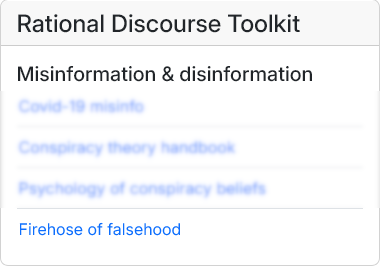
The Rational Discourse Toolkit section of piefed.social includes the firehose of falsehood among its resources on misinformation. The term was coined to refer to one of Russia’s propaganda techniques, utilized around its invasion of Georgia in 2008 and beyond.
According to RAND, the firehose of falsehood model has four distinguishing factors:
It is high-volume and multichannel.
It is rapid, continuous, and repetitive.
It lacks a commitment to objective reality.
It lacks commitment to consistency.The high volume of messages, the use of multiple channels, and the use of internet bots and fake accounts are effective because people are more likely to believe a story when it appears to have been reported by multiple sources. For example, in addition to the recognizably-Russian news source RT, Russia disseminates propaganda using dozens of proxy websites whose connection to RT are “disguised or downplayed”. People also are more likely to believe a story when they think many others believe it, especially if those others belong to a group with which they identify. Thus, a group of operatives can influence a person’s opinion by creating the false impression that a majority of that person’s neighbors support a given view.
The full RAND report goes further into the technique.