I can point to good studies and government modelling too that find immigration reduces wages, it’s a pointless internet battle…
The key difference between all the research is in the subgroups of workers compared and a few issues trying to study it:
Immigrants choose where to go, often to booming places, which can mask wage effects.
Natives and firms adjust (people move, capital flows in, jobs get reorganised), which dilutes local comparisons.
National-level studies avoid that problem but depend on modelling assumptions, such as how substitutable workers are.
This prompts the debate of skilled migrants vs unskilled, which leads to looking at how wages reduce or stagnate for professionals when there are high rates of skilled immigration aaaand we’re back at square one
Today, the United States is home to the largest immigrant population in the world. Even though immigrants
assimilate faster in the United States compared to developed European nations, immigration policy has become a highly contentious issue in America. While much of the debate centers on cultural issues, the economic effects of immigration are clear: Economic analysis finds little support for the view that inflows of foreign labor have reduced jobs or Americans’ wages. Economic theory predictions and the bulk of academic research confirms that wages are unaffected by immigration over the long-term and that the economic effects of immigration are mostly positive for
natives and for the overall economy.
Key points
While some policymakers have blamed immigration for slowing U.S. wage growth since the 1970s, most
academic research finds little long run effect on Americans’ wages.
The available evidence suggests that immigration leads to more innovation, a better educated workforce,
greater occupational specialization, better matching of skills with jobs, and higher overall economic
productivity.
Immigration also has a net positive effect on combined federal, state, and local budgets. But not all taxpayers
benefit equally. In regions with large populations of less educated, low-income immigrants, native-born
residents bear significant net costs due to immigrants’ use of public services, especially education.
It’s pretty disgusting you’d try to use this misleading appeal to authority, attempting to frame this as some reputable government finding when it’s only just a third party document mirrored by the congress website. Let’s dive into the obvious problems here.
Unknown author and funding: No named author, no disclosure, no sign of peer review.
Advocacy-linked sources: Key claims cite Cato, NFAP (Stuart Anderson) and the Partnership for a New American Economy. All are policy advocacy organisations.
It’s 9 pages with no original analysis beyond a couple of charts. Its conclusions depend on a handful of studies chosen by the author.
Old data: It’s a 2016 brief using 2009-2013 figures, so it misses the post-2020 immigration surge, post-pandemic labour markets and recent fiscal studies.
“Economists generally agree”: The only support is a 2013 IGM expert poll in a footnote.
Contested findings downplayed: Borjas’s estimate that 1980-2000 immigration cut wages about 3% is footnoted, then treated as an outlier.
Static framing: It doesn’t model scenarios, uncertainty ranges or sensitivity to assumptions.
The brief’s chain of reasoning is that immigration adds labour supply, wages dip, firms invest more, capital per worker recovers, and so wages recover. Except no evidence is presented for wage recovery. The theory needs capital per worker to hold. Wages also depend on labour’s share of income, which the brief admits has fallen since 2000. It dismisses that in a footnote as “technology and globalisation”
The two studies in Table 2 are simulations that build in the investment response and imperfect substitutability between immigrants and natives. The roughly +0.5 percentage point result for native wages depends partly on those assumptions, so it is not an observed wage change.
I could go on but the fact you’re trying to claim this very misleading report produced by lobbyists is reputable is insane. If anything, it strongly supports immigration causing immediate dip in wages. They have a theoretical simulated scenario to suggest wages might improve afterwards.
It is a peer reviewed non-partisan Congressional report about the country with the most immigrants in the world. Clearly you are much smarter than these experts.
Edit: Just a few more sources all saying the exact same thing. Feel free to do your arm chair AI dissection.


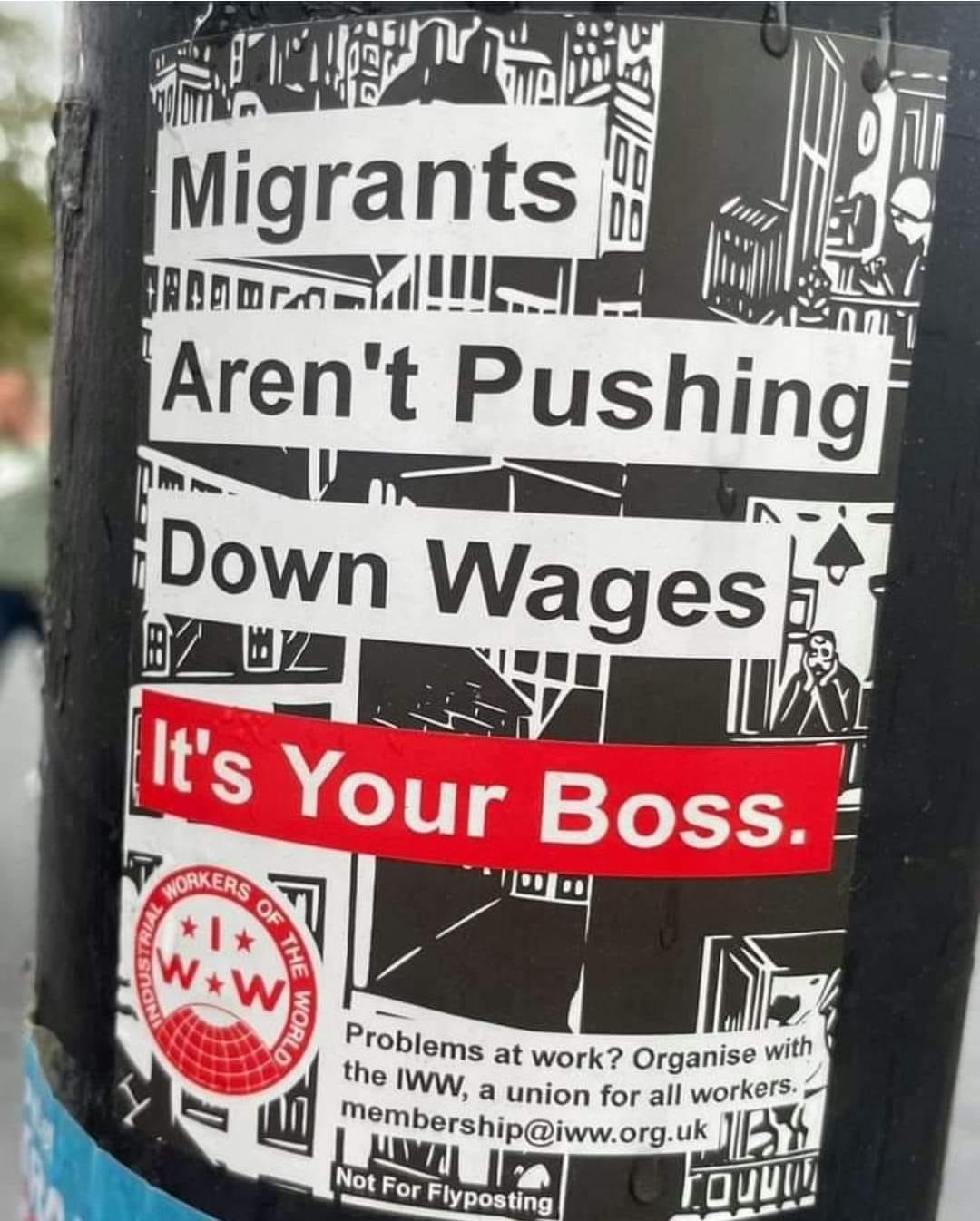
Assuming there can only be a fixed number of jobs, you’re right. However, that’s like solving for spherical chickens in vacuum.
To see why immigration is not a factor, see https://lemmy.world/post/53479187/26477182
I can point to good studies and government modelling too that find immigration reduces wages, it’s a pointless internet battle…
The key difference between all the research is in the subgroups of workers compared and a few issues trying to study it:
Immigrants choose where to go, often to booming places, which can mask wage effects.
Natives and firms adjust (people move, capital flows in, jobs get reorganised), which dilutes local comparisons.
National-level studies avoid that problem but depend on modelling assumptions, such as how substitutable workers are.
This prompts the debate of skilled migrants vs unskilled, which leads to looking at how wages reduce or stagnate for professionals when there are high rates of skilled immigration aaaand we’re back at square one
You can point out a couple of flawed studies against a mountain of contrary evidence.
https://www.congress.gov/118/meeting/house/116727/documents/HHRG-118-JU01-20240111-SD013.pdf
Intro
Today, the United States is home to the largest immigrant population in the world. Even though immigrants assimilate faster in the United States compared to developed European nations, immigration policy has become a highly contentious issue in America. While much of the debate centers on cultural issues, the economic effects of immigration are clear: Economic analysis finds little support for the view that inflows of foreign labor have reduced jobs or Americans’ wages. Economic theory predictions and the bulk of academic research confirms that wages are unaffected by immigration over the long-term and that the economic effects of immigration are mostly positive for natives and for the overall economy.
Key points
While some policymakers have blamed immigration for slowing U.S. wage growth since the 1970s, most academic research finds little long run effect on Americans’ wages.
The available evidence suggests that immigration leads to more innovation, a better educated workforce, greater occupational specialization, better matching of skills with jobs, and higher overall economic productivity.
Immigration also has a net positive effect on combined federal, state, and local budgets. But not all taxpayers benefit equally. In regions with large populations of less educated, low-income immigrants, native-born residents bear significant net costs due to immigrants’ use of public services, especially education.
It’s pretty disgusting you’d try to use this misleading appeal to authority, attempting to frame this as some reputable government finding when it’s only just a third party document mirrored by the congress website. Let’s dive into the obvious problems here.
Unknown author and funding: No named author, no disclosure, no sign of peer review.
Advocacy-linked sources: Key claims cite Cato, NFAP (Stuart Anderson) and the Partnership for a New American Economy. All are policy advocacy organisations.
It’s 9 pages with no original analysis beyond a couple of charts. Its conclusions depend on a handful of studies chosen by the author.
Old data: It’s a 2016 brief using 2009-2013 figures, so it misses the post-2020 immigration surge, post-pandemic labour markets and recent fiscal studies.
“Economists generally agree”: The only support is a 2013 IGM expert poll in a footnote.
Contested findings downplayed: Borjas’s estimate that 1980-2000 immigration cut wages about 3% is footnoted, then treated as an outlier.
Static framing: It doesn’t model scenarios, uncertainty ranges or sensitivity to assumptions.
The brief’s chain of reasoning is that immigration adds labour supply, wages dip, firms invest more, capital per worker recovers, and so wages recover. Except no evidence is presented for wage recovery. The theory needs capital per worker to hold. Wages also depend on labour’s share of income, which the brief admits has fallen since 2000. It dismisses that in a footnote as “technology and globalisation”
The two studies in Table 2 are simulations that build in the investment response and imperfect substitutability between immigrants and natives. The roughly +0.5 percentage point result for native wages depends partly on those assumptions, so it is not an observed wage change.
I could go on but the fact you’re trying to claim this very misleading report produced by lobbyists is reputable is insane. If anything, it strongly supports immigration causing immediate dip in wages. They have a theoretical simulated scenario to suggest wages might improve afterwards.
It is a peer reviewed non-partisan Congressional report about the country with the most immigrants in the world. Clearly you are much smarter than these experts.
Edit: Just a few more sources all saying the exact same thing. Feel free to do your arm chair AI dissection.
https://www.americanimmigrationcouncil.org/blog/immigrants-do-not-take-americans-jobs-wages/
https://docs.house.gov/meetings/JU/JU01/20251217/118767/HHRG-119-JU01-20251217-SD001-U1.pdf
https://www.cato.org/blog/immigrants-dont-lower-blue-collar-american-wages
https://immigrationlab.org/2017/08/31/fact-check-immigration-harm-american-workers/
https://theconversation.com/nobel-winner-david-card-shows-immigrants-dont-reduce-the-wages-of-native-born-workers-169768
https://www.brookings.edu/articles/what-immigration-means-for-u-s-employment-and-wages/
https://pmc.ncbi.nlm.nih.gov/articles/PMC8612123/
https://migrationobservatory.ox.ac.uk/resources/briefings/the-labour-market-effects-of-immigration/
https://timesofsandiego.com/politics/2016/09/21/influential-report-finds-immigrants-dont-lower-wages-or-steal-jobs/
https://ucalgary.ca/news/nobel-winner-david-card-shows-immigrants-dont-reduce-wages-native-born-workers
With ALL key sources being policy advocates?
Stop pretending and go shovel your AI slop somewhere else.