

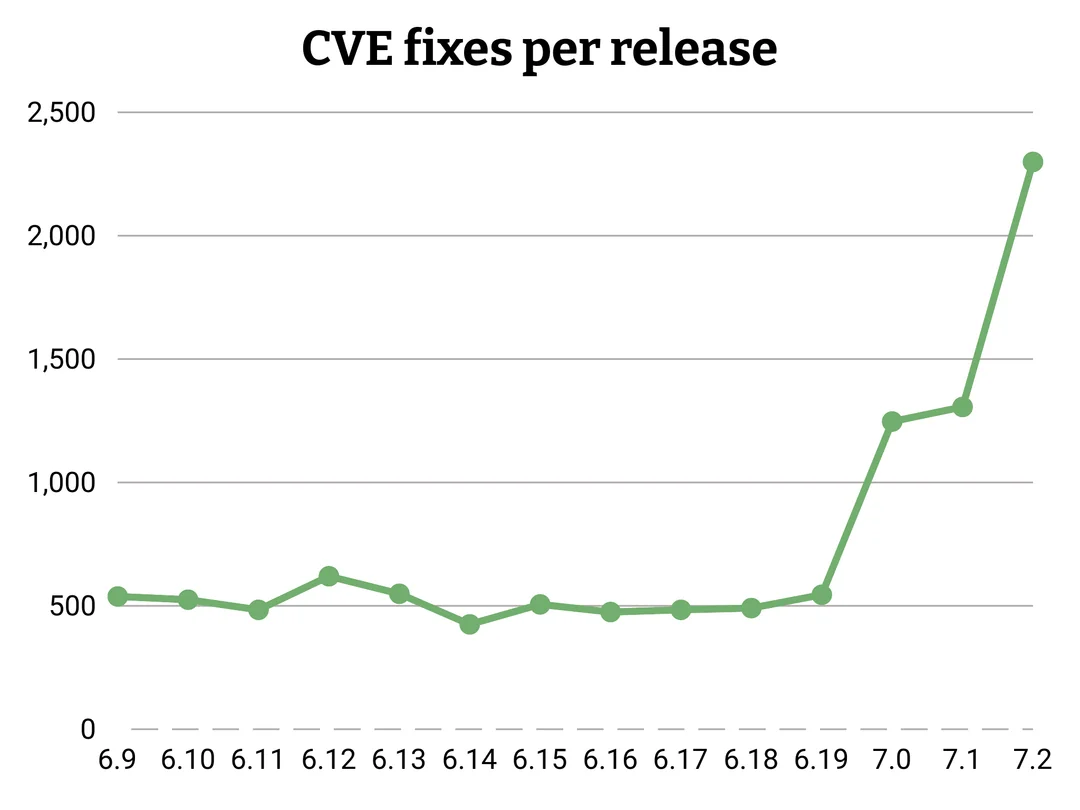

AI coding tools are pretty good at finding bugs and make it easier and faster to fix them.
Importantly, security vulnerabilities in new releases seem to stay roughly the same and the change to which bugs count as CVEs was around version 6.8 already.
AI coding tools are pretty good at finding bugs and make it easier and faster to fix them.
Importantly, security vulnerabilities in new releases seem to stay roughly the same and the change to which bugs count as CVEs was around version 6.8 already.
in that case i should have been more clear. i do not believe it’s strictly one or the other, which is why the word “entirely” is in there. you’re generalising over a huge range of developer quality and basically saying that they are all worse at building software than linus, despite the fact that we have been seeing regressions in projects like rsync, which has one of the most disciplined maintainers in the foss ecosystem.
You claimed that Linux could see regressions just like all other projects DESPITE the different methodology.
That is claim that any AI use of any type results in regressions. That is obviously false.
Just because AI suggested using glue on pizza doesn’t mean that everyone now puts glue on their pizza.
i claimed no such thing. i asked for a graph because i was interested to know if that was the case.
and what we’ve been seeing in the industry lately is that llm use of any kind results in more regressions, because more code is created and it tends towards average quality.