

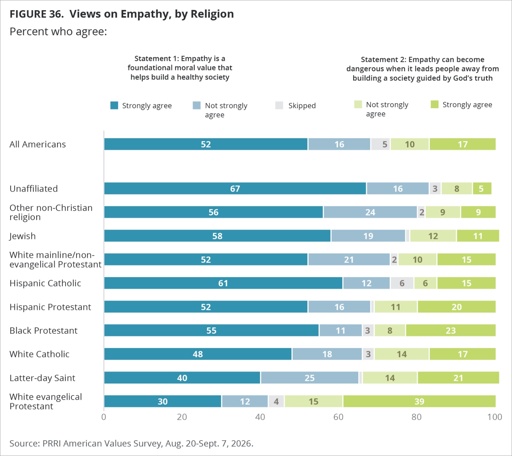
Religiously unaffiliated people most strongly believe that empathy is a foundational moral value. Note that doesn’t necessarily mean atheists; people who believe in God but don’t associate with any particular religion would be in that group. In fact, I can’t find any information about whether atheists are included in this survey, or if this was exclusively a survey of religious people.
Interesting (but not exactly surprising) results here. Makes me glad that “religiously unaffiliated” is the fastest growing religion in the U.S.
You must log in or register to comment.
The way people talk about empathy on the fediverse while denouncing and haranguing people they claim to lack it tells me they haven’t really internalized it, and they maybe talk it up for social currency.
Empathy can only approach fair & impartial judgement when we apply it equally by extending it to those we don’t relate to—when we seriously try.
I have (and probably everyone has) observed enough people rush to judgement with a great deal of empathy for those they can relate to while making 0 effort for people they don’t understand.
They’re assholes with empathy.Empathy is trendy to invoke, especially in social media.
The popular premise seems to be that we can solve the moral failings in society if we’d all just develop our psychological health to better contemplate how others feel.
While that may help, it’s incredibly reductive.Feeling is a very low bar that doesn’t set a standard.
Empathy doesn’t stop someone from being an asshole.
It doesn’t imply proper action or duty.
A subjective feeling prone to error, misjudgment, and uneven results is not a reliable basis of moral judgment & conduct.Plus, it seems like a reversion to a type of virtue ethics that suggests morality simply amounts to having empathy.
Isn’t it a bit more than that, and aren’t there systems of ethics to better model it?I remember a time when instead of talking about empathy, people talked way more about acting & treating everyone with basic decency and standards.
They might have even brought up a social contract or the golden rule.
They’d imply society has or ought to have rights, duties, and universal principles to judge moral conduct.
Those quaint ideas at least affirm some objective, external standard unlike empathy, and I think it’s overdue to restore those ideas to prominence in popular discourse.See?
Like right there: I explain that there’s way more to morality & ethics than empathy (whose flaws are obvious enough to motivate philosophers to base systems of ethics on universal principles instead), and someone too superficial to bear the thought that their sacred cow has legitimate issues goes downvoting instead.
Empathy at the fediverse is performative.
Purporting to care about empathy, however, is very popular.
The survey may just reflect that superficiality when serious ethicists & philosophers wouldn’t consider empathy a great foundation either.The issue is that propaganda has redefined “empathy” to mean “giving tons of free money to freeloading brown people”, which makes it an easy thing to turn ignorant racists against.
The other issue is that the US education system has failed rural citizens to the extent that many of them are ignorant racists.
As a resident of Utah, I’m surprised by the Mormon numbers. Kinda. In my experience, many Mormons outside of the Idaho-Utah-Arizona belt tend to be more liberal, so that might be why.
Seeing the numbers for blacks and Hispanics saddens me. That’s how the Republicans manage to get votes there.
Hi fellow Utahn! SLC here. I kind of expect Mormon numbers (across all kinds of opinions) to more closely match Evangelical numbers going forward. To me, it looks like Mormons fall into two groups these days: those who are all-in on the alpha male/tradwife culture, and those who are on their way out of Mormonism. The first group will make LDS opinions match Evangelical opinions, especially when the second group is no longer included in the LDS numbers.
I don’t intuitively disagree with the premise that non-religious people are more motivated by empathy than religious people, but statement 2 using the phrase “God’s truth” seems like it would make atheists or agnostics less likely to choose it than if it were worded more neutrally.
Are these numbers supposed to be a revelation or give new insights? If you asked me if empathy should get in the way of justice and ritiousness (not divine interpretations, just morally correct), I would also say hell no. People don’t want anything to be allowed to get in the way of what they beleive is the ultimate correct thing-

