i wonder how this will affect the grid. it will for sure flatten out the curve during the day, maybe even leading to excess capacity we’d have to burn off. what magnitude of storage would we need to actually use all the extra power?
Hmmm, this has been part of the debate since solar power started up. Batteries both grid and home size are being installed all over. The cost is falling rapidly and the grid forming batteries are providing all the services of a power station.
there are still pretty big problems with them though, like materials and cost. i’d love it if every home could top up the grid but the forming inverters are bulky and costly for individuals. hopefully used traction batteries can start making up the difference in cost but personally i’d rather see more large-scale solutions like pumped hydro.
also, anecdotally, as someone in a country where we were already basically fossil-free, with a 50-50 split between hydro and nuclear, installing more renewables has coincided with the grid becoming less stable. the rapid fluctuations in available power has seemingly driven up energy costs. i theorise it’s because larger variations in grid frequency is more taxing on the hardware.
the rapid fluctuations in available power has seemingly driven up energy costs. i theorise it’s because larger variations in grid frequency is more taxing on the hardware.
You need batteries for this which in turn make things cheaper and more reliable overall.
that here, there are no plans for integrating battery technology into the grid, no plans for where to get them, and no system to regulate their use. what we do have is lots of old pumped hydro facilities that were shut down because they were “not profitable enough”.
I mean ya, if you don’t have plans to do it, then it doesn’t happen, but batteries are what help stabalize solar/wind input. If they have decided to go into solar/wind and you’re having grid instabilities because of it, they should build batteries.
The batteries also help with the Nuclear plants since they often don’t run at full capacity overnight which is wasted energy as they need to spin them down. If you have batteries you can also be storing that during the evening, which means you need less solar during the day.
Massively increased long-distance transmission lines between different climates are a must. A lot of investments are being made there but it turns out building thousands of miles of high voltage lines is a pretty slow process now that it isn’t the 50s and 60s.
My utility provider gives lower rates during 1000 to 1500. People are setting their washing machines (timers), air conditioner (house as a thermal battery), oven (not all stuff, but some) etc on a timer. I’m sure some companies could adjust their processes to take advantage of excess solar: run more equipment and harder in preferential times, etc.
There are products like UPS+battery which are trying to add battery storage to well matched products and these might go a long way to provide a 1-5% storage for most houses and companies in future, just enough to tide over the duck curve in mornings and evenings.
Hopefully the rest can be managed by the utility providers
Pumped hydro accounts for 95% of grid scale storage. It’s the only thing viable for significant energy storage with batteries taking on more of a capacitor role.
The reason pumped hydro is 95% (if that’s true) is because until very recently batteries weren’t a viable option and available in the scale required.
That’s no longer the case. There’s limits to where you can do pumped hydro, but pretty much anywhere you can drop a solar array down, you can drop a substantial amount of batteries.
Batteries are going to dwarf pumped hydro in the not so distant future.
Edit: To put this into perspective, the USA has ~553 GWh of pumped storage. Tesla alone in the USA has 1 40GWh factory running, and a 50GWh factory about to come online, so they’ll have a yearly 90GWh install capacity, 130GWh if you include the China factory. Then there’s BYD, CATL, Panasonic and LG all doing battery storage, and things like Sodium batteries are about to come online at scale that are even cheaper.
That’s because of capitalism. Pumped hydro has huge startup costs and a long payoff period, but runs basically forever. That’s not good next quarter stock market returns.
Batteries are exactly the disposable need to be completely thrown out and re bought every 5-10 years that the private sector loves to sell the government.
Pumped hydro beats batteries $/KwH before the first time you have to throw them all out every time.
You talk about China, and they’re doing exactly what I said. They’re building pumped hydro capacities over 10x their battery storage capacity.
Again I’m not against batteries they’re a great complimentary technology for surge demand and local backup. But nothing beats the simplicity and efficiency of moving water from a mountain Lake to a valley lake.
Commercial scale grid batteries last 15-20 years and can be deployed in months not years, and the permitting is dramatically less. The grid batteries will be up and earning profits before you even break ground on those pumped hydro locations.
But yes I’m sure once you build the pumped hydro it can be cheaper over decades. Also unless they’re a closed loop system, they’re susceptible to drought which could impact their usage in the future.
Yeah. That’s what I said. Grid scale batteries create lots of profit for big corps. But if you want cost effective long term massive capacity energy storage you go pumped hydro. You can guess who fucked up our regulations and stopped our governments from pursuing these kinds of nation building projects: the same corps selling us batteries and coal and gas power. All based on the idea of endless fuel and battery purchases from them. They also did the same to solar, hydro, wind, and nuclear energy because those don’t really have recurring costs they can profit on forever.
Drought is generally not a concern for pumped hydro because you control the flow and you can pump both ways. In some cases it’s part of a normal hydro generation plant at a dam and then maybe some places might have minor drought susceptibility, but that affects net energy generation rather than storage capacity.
I don’t think one really has to burn off solar capacity? Just raise the inverter input to match the voltage and no current will flow. Would be kind pointless to waste the capacity though, I think Sweden or somewhere had success with melting salt with excess power.
The incoming sunlight will still get converted into electrical energy, it’s just going to get burned of right there inside the panel instead of somewhere else on the grid.


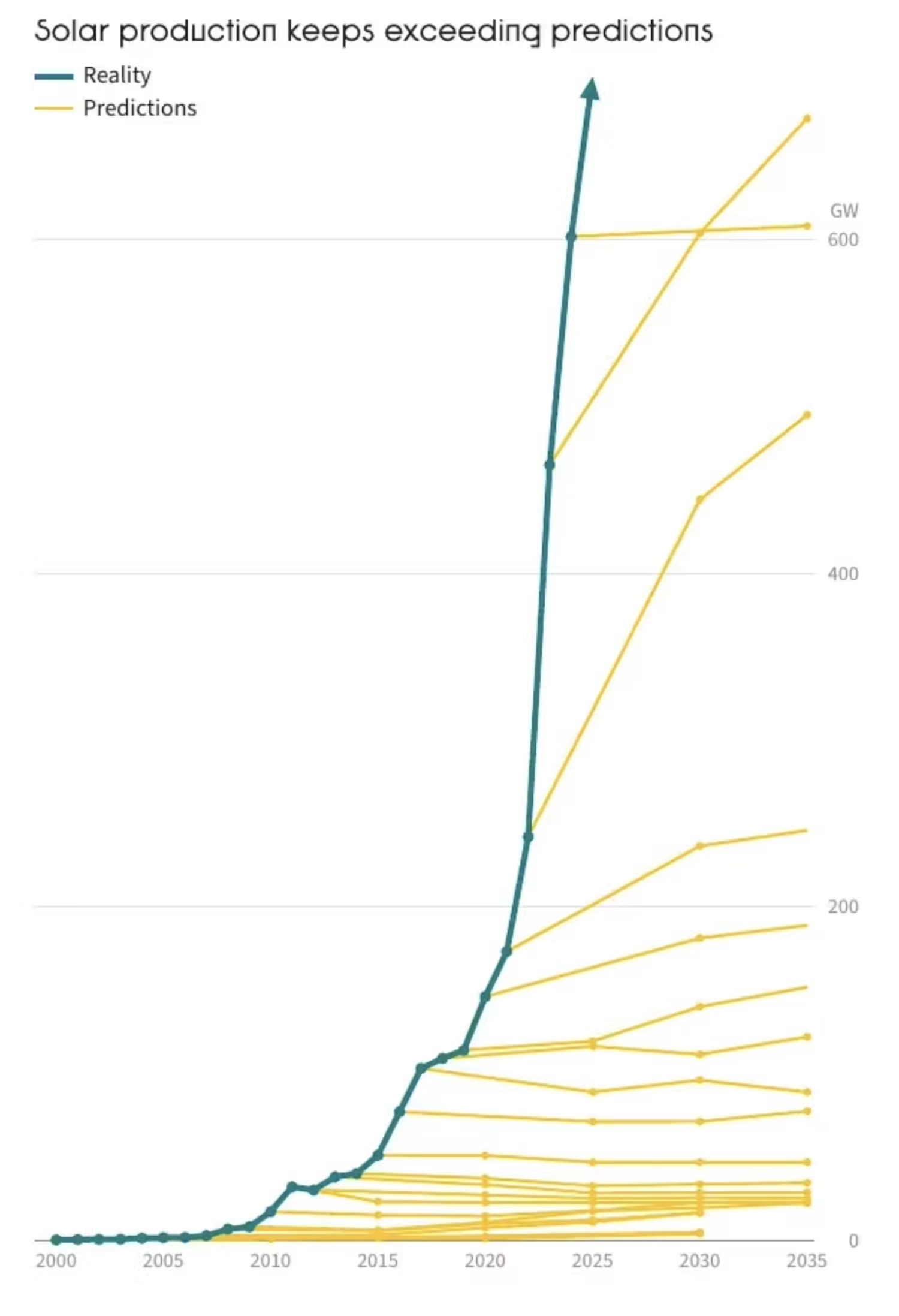
i wonder how this will affect the grid. it will for sure flatten out the curve during the day, maybe even leading to excess capacity we’d have to burn off. what magnitude of storage would we need to actually use all the extra power?
Hmmm, this has been part of the debate since solar power started up. Batteries both grid and home size are being installed all over. The cost is falling rapidly and the grid forming batteries are providing all the services of a power station.
there are still pretty big problems with them though, like materials and cost. i’d love it if every home could top up the grid but the forming inverters are bulky and costly for individuals. hopefully used traction batteries can start making up the difference in cost but personally i’d rather see more large-scale solutions like pumped hydro.
also, anecdotally, as someone in a country where we were already basically fossil-free, with a 50-50 split between hydro and nuclear, installing more renewables has coincided with the grid becoming less stable. the rapid fluctuations in available power has seemingly driven up energy costs. i theorise it’s because larger variations in grid frequency is more taxing on the hardware.
Force home solar to have grounding maybe
You need batteries for this which in turn make things cheaper and more reliable overall.
you need to get those batteries from somewhere.
Whats your point? Yes when you build something you need to get said something from somewhere.
that here, there are no plans for integrating battery technology into the grid, no plans for where to get them, and no system to regulate their use. what we do have is lots of old pumped hydro facilities that were shut down because they were “not profitable enough”.
I mean ya, if you don’t have plans to do it, then it doesn’t happen, but batteries are what help stabalize solar/wind input. If they have decided to go into solar/wind and you’re having grid instabilities because of it, they should build batteries.
The batteries also help with the Nuclear plants since they often don’t run at full capacity overnight which is wasted energy as they need to spin them down. If you have batteries you can also be storing that during the evening, which means you need less solar during the day.
cool
It is economical to store the surplus, so it will happen.
Massively increased long-distance transmission lines between different climates are a must. A lot of investments are being made there but it turns out building thousands of miles of high voltage lines is a pretty slow process now that it isn’t the 50s and 60s.
My utility provider gives lower rates during 1000 to 1500. People are setting their washing machines (timers), air conditioner (house as a thermal battery), oven (not all stuff, but some) etc on a timer. I’m sure some companies could adjust their processes to take advantage of excess solar: run more equipment and harder in preferential times, etc.
There are products like UPS+battery which are trying to add battery storage to well matched products and these might go a long way to provide a 1-5% storage for most houses and companies in future, just enough to tide over the duck curve in mornings and evenings.
Hopefully the rest can be managed by the utility providers
that only works for people who own their homes, unfortunately.
Pumped hydro and grid-scale battery storage seem to be the two main methods.
Pumped hydro accounts for 95% of grid scale storage. It’s the only thing viable for significant energy storage with batteries taking on more of a capacitor role.
The reason pumped hydro is 95%
(if that’s true)is because until very recently batteries weren’t a viable option and available in the scale required.That’s no longer the case. There’s limits to where you can do pumped hydro, but pretty much anywhere you can drop a solar array down, you can drop a substantial amount of batteries.
Batteries are going to dwarf pumped hydro in the not so distant future.
Edit: To put this into perspective, the USA has ~553 GWh of pumped storage. Tesla alone in the USA has 1 40GWh factory running, and a 50GWh factory about to come online, so they’ll have a yearly 90GWh install capacity, 130GWh if you include the China factory. Then there’s BYD, CATL, Panasonic and LG all doing battery storage, and things like Sodium batteries are about to come online at scale that are even cheaper.
https://www.energy.gov/cmei/water/hydropower-market-reports (553 source)
That’s because of capitalism. Pumped hydro has huge startup costs and a long payoff period, but runs basically forever. That’s not good next quarter stock market returns.
Batteries are exactly the disposable need to be completely thrown out and re bought every 5-10 years that the private sector loves to sell the government.
Pumped hydro beats batteries $/KwH before the first time you have to throw them all out every time.
You talk about China, and they’re doing exactly what I said. They’re building pumped hydro capacities over 10x their battery storage capacity.
https://oilprice.com/Alternative-Energy/Hydroelectric/China-Records-Hydropower-Boom-Amid-Power-Storage-Push.html
Again I’m not against batteries they’re a great complimentary technology for surge demand and local backup. But nothing beats the simplicity and efficiency of moving water from a mountain Lake to a valley lake.
Commercial scale grid batteries last 15-20 years and can be deployed in months not years, and the permitting is dramatically less. The grid batteries will be up and earning profits before you even break ground on those pumped hydro locations.
But yes I’m sure once you build the pumped hydro it can be cheaper over decades. Also unless they’re a closed loop system, they’re susceptible to drought which could impact their usage in the future.
Yeah. That’s what I said. Grid scale batteries create lots of profit for big corps. But if you want cost effective long term massive capacity energy storage you go pumped hydro. You can guess who fucked up our regulations and stopped our governments from pursuing these kinds of nation building projects: the same corps selling us batteries and coal and gas power. All based on the idea of endless fuel and battery purchases from them. They also did the same to solar, hydro, wind, and nuclear energy because those don’t really have recurring costs they can profit on forever.
Drought is generally not a concern for pumped hydro because you control the flow and you can pump both ways. In some cases it’s part of a normal hydro generation plant at a dam and then maybe some places might have minor drought susceptibility, but that affects net energy generation rather than storage capacity.
I don’t think one really has to burn off solar capacity? Just raise the inverter input to match the voltage and no current will flow. Would be kind pointless to waste the capacity though, I think Sweden or somewhere had success with melting salt with excess power.
are you thinking of the finnish sand battery?
Ah that’s the one, yep
The incoming sunlight will still get converted into electrical energy, it’s just going to get burned of right there inside the panel instead of somewhere else on the grid.