

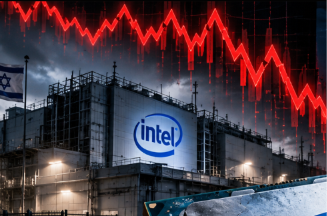
is the bubble finally bursting? i thought it would be way higher than 29%
Intel stock is up over 200% over the last 2 years (even with this 29% drop) so it’s way too early to say it’s popped.
The fun thing about percentages though: you can have a 10,000% gain, but a 100% drop is an instant wipeout. So a 29% drop can still be more significant than what the value was two years ago.
I always thought that Intel was what kept AMD in place being a cool producer of linux-friendly components, so I pretty much dread the day AMD gets to be free from the shackles of competition.
I’m keeping an eye on the RISC-V space. Not far off now… I hope

Unrelated to the topic discussed, but I absolutely hate that GIF’s ability to spike my anticipation and never pay it off.
You have to watch just a little longer - trust me!

Pretty far off but China has some nice manufacturers…or they would if AI didn’t exist.
This is generally the problem with ISAs.
ARM has had decades in the oven, x86 has had almost half a century, while RISC-V manufacturing and ISA development has been generally available only a couple of years.
The fact is if there isn’t a big push by some major vendor - or some nation state, then chances are it’ll develop slower than the previously mentioned ISAs.
From design, to testing, to prefab, to packaging, it’s all combined just a single step of the journey to improving yield and performance.
ARM is unfortunately the current trajectory, with Qualcomm, Apple and now NVIDIA leading the charge - which doesn’t bode well, simply because you won’t know what the hell the firmware do.
We could truly use some market disruption in this space and RISC-V, being an open ISA, would be the safest bet for digital sovereignty and user autonomy - but apparently those things are only important on paper.
As an European I’m ashamed that we have 0 presence in this market
Not true. The Netherlands has ASML, sort of a monopoly on the manufacturing of semiconductor machines.
Yeah but no actual semiconductors made here.
Well yeah because that is a near monopoly in Taiwan with TSMC. It is a supply chain and every part in that chain is just as valuable. There is a serious presence of Europe/The Netherlands in the form of ASML in the chip market. It is one of the bargaining chips of the Dutch government when it deals with the United States.
Isn’t that just cope, to an extent? Yes, ASML is key to advanced semiconductors, but in a conflict or crisis that disrupts supply chains, who is going to run dry quicker - the ones able to build the thing that’s needed for building fabs, or the ones who actually operate working fabs? My money is on the latter :/
Also, just because ASML is currently the only one capable of building EUV systems, does not mean it’s guaranteed to stay that way forever. The Chinese sure are trying to follow suit…
These are valid worries, never claimed those weren’t the case. However, saying Europe has “no presence in that market” is also not true, the presence is significant.
Strategically it would be smart to have working fabs in Europe too, it would just take a lot of time and investment. America already started working on it (if I remember correctly) and China is already closing in…
Fair, the world is rather nuanced after all. And you’re right, there is indeed some presence there. I’m not convinced every part of the supply chain holds equal value, but that’s subjective, I suppose.
Strategically it would be smart to have working fabs in Europe too, it would just take a lot of time and investment. America already started working on it (if I remember correctly) and China is already closing in…
Yeah, I wish. Our (=German) previous minister of economic affairs tried doing that, but a combination of Intel (maybe not the best choice in hindsight, but I don’t blame him for that) and the government getting replaced by the current one lead by our beloved Friedrich Merz (yay Neoliberalism) put a stop to that for the foreseeable future. At least we still have some semiconductor manufacturing in Europe, that should make any potential catching up much easier than it otherwise would be.
In the case of a war, it would take just one drone to stop production for a very long time in one factory. Factories are big fat juicy targets that can’t move.
a) I seriously doubt it would be that simple, factories typically don’t stop production like that after a single hit (Perun talked about it recently). And even if a semiconductor fab was that brittle in and of itself, sophisticated air defense and a location deep inside, say, European or Chinese mainland might disagree with this notion. And if one really wanted to, it would be possible to move production underground.
b) ‘Conflict’ is what I wrote, not (hot) war. Owning and running semiconductor fabs domestically might well be indispensable in a cold/trade war.