

So, you kids like bootleg stuff, do ya? Boy, have I got a whopper for you.
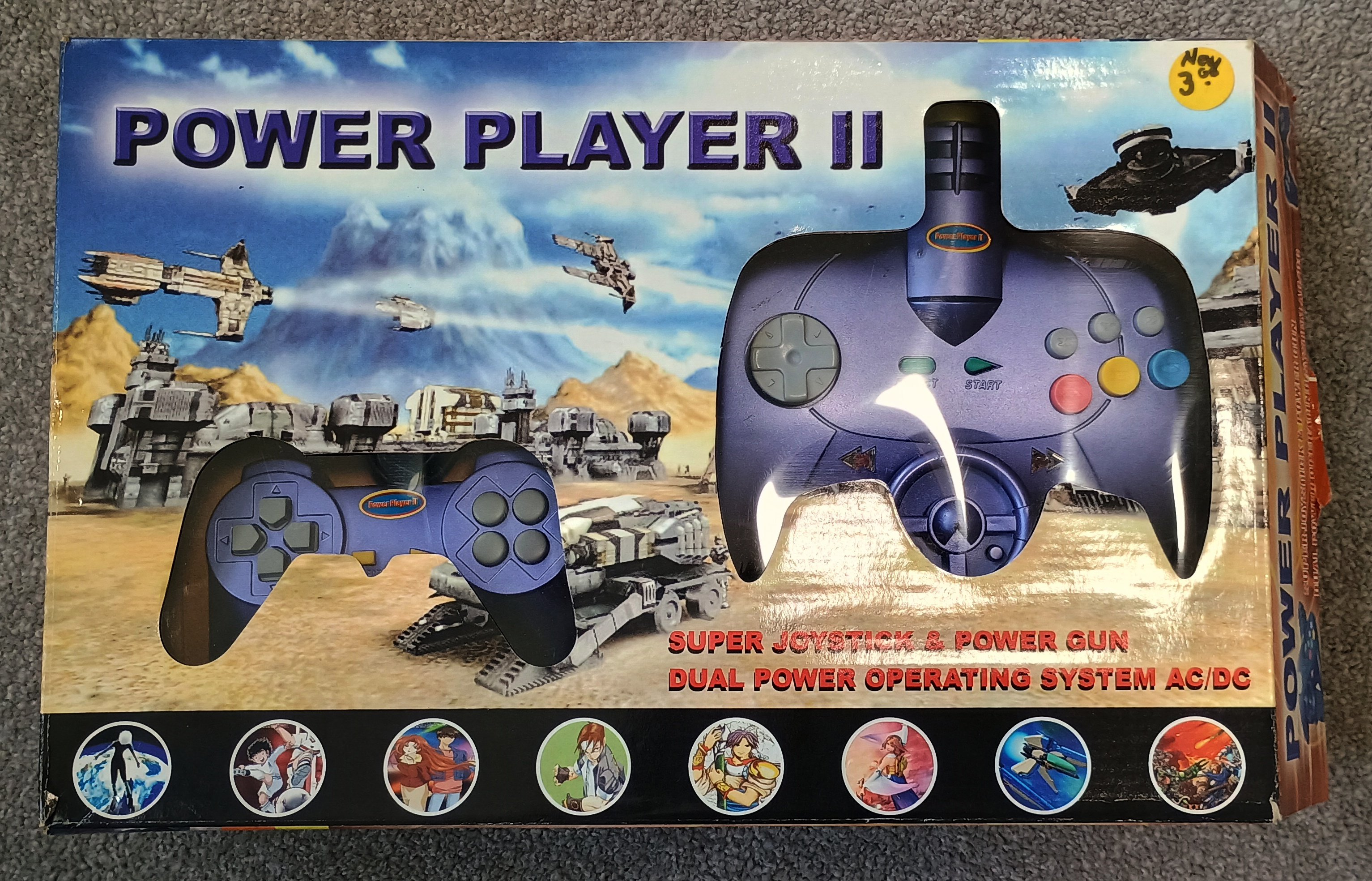
This is the “Power Player 2,” a bootleg gaming device… thing… from China. Its humble purple shell belies a whole bunch of puzzle pieces that all fit together culminating specifically in what it is; a veritable rabbit hole of retro gaming trivia and a history lesson – packaged as a warning from the past.
And yes, apparently there was an original “Power Player,” the OG. I’ve seen it on the internet. But this one’s the sequel.
Right out of the gate, this fucker is the real deal. It ain’t no Spooderman nonposeable figurine or Justice Chumps vinyl backpack. Oh, no. We’re well beyond that kind of thing already.
You will note I paid three dollars for this based on the yellow sticker in the top left corner, there. I found this and bought it new at an outdoor flea market in I want to say 2016. And remember that date. It sets up a punchline that’ll be delivered much later.
First, let’s point and laugh at the box. As is tradition there is not a single square inch wasted on specifying just who the hell alleges to manufacture this thing. It’s brandless and doesn’t even have a SKU or model number designation on it. Instead, it’s just a smorgasboard of wacky imagery both stolen and completely bootleg. All of it’s ridiculous and as usual it seems nobody in China has heard of what an aspect ratio is so some of it is presented to you squashed. All of these are hallmarks of some classic Chinese bootleg shit. You can play along at home and try to identify the stuff I can’t call out right off the top of my head. For a start, the desert battle scene comprising the main background. I have no idea where that’s from, or even if it’s from anything.

From left to right, we’ve got: Generic Anime Prettyboy floating in front of the Earth. From something I’m sure, but my nerd skills fail me and I don’t know what. Then there’s Tsubasa Oozora (not appearing in this product), Kaho Mizuki and Toya Kinomoto from Cardcaptor Sakura (not appearing in this product), and I’m sorry… is that supposed to be Kyo Kusanagi? (Also not appearing in this product.) Somebody who’s so off model I can’t place them, then Yuna from Final Fantasy 10 (not appearing in this product), the RVR-01 Gauntlet from Thunderforce V (not appearing in this product), and… Yes, the last one is from Warhammer. Not. Appearing. In. This. Product.

The back’s nearly as good. In addition to making sure you know it’s both a SUPER JOYSTICK and a POWER GUN, its’ also got Duo Maxwell and his Gundam Deathscythe (you guessed it, not in here anywhere). The space battle picture was apparently just nicked from the Internet; I found it here.
Whew. We haven’t even plugged this thing in yet and we’ve already struck gold.
But what the hell, you say, actually is it?

This is one of those plug-and-play TV games which were popular in the early oughts but not, it must be said, exactly the type you’d find in the toy aisle of your local CVS. In addition to all the other dumb crap I collect that some of you have heard me rattle on about for pages and pages already, at one point I developed a predilection for this sort of thing. I have a few of them.

That particular spread of connectors has already clued some of you into exactly what’s, er, powering the Power Player II.

At its heart is this contraption. No, what you can see through the box really doesn’t do it justice. Flaking paint and a questionable injection molding job and everything, it’s all here. Apparently while it was in the container ship on its way here, the rubber bands on the cables on mine perished, and got latex boogersnot all over both my machine and its cables, which when removed caused the paint to come up with it. So we’ve already got a sterling testament to the finish quality right there.
What we’ve got is half of a Genesis 6 button pad, one quarter Dreamcast controller, and one quarter Little Tykes car. It’s got a D-pad, six fire buttons, and a steering wheel.
The steering wheel’s not proportional, by the way. It is functional for sure, but not analog. To make up for it, it’s got red LED blinkers that light up either side of it when you turn it.

In reality the wheel just duplicates the left and right inputs of the D-pad. That means the blinkers light up when you press those directions on the pad as well.

For two player action, it comes with this dinky secondary controller. Obviously this really, really wants to pretend to be a Playstation pad but it’s only about half scale.
It’s pretty weird for a plug-and-play TV game to have simultaneous two player capability, but the Power Player II’s got more surprises than that on it.

For instance, it comes with this slide-on pistol grip. This docks onto the bottom of the main controller and turns it into a fucking gun.

You know how the N64 had that third handle on the controller? Well, it’s got nothing on this now.

I’m also somewhat ashamed to note that in all the years I’ve had this thing, I’ve never noticed that the bottom of the pistol grip can be opened revealing this trap door, and you can stuff four AA batteries in there to power the Player without the need for its funky wall wart power supply. This despite it saying “DUAL POWER OPERATING SYSTEM AC/DC” right there on the box. I mean, duh.

While we’re on the topic of the wall wart, even that’s weird. It’s got one of the only US style plugs I’ve ever seen without the customary holes in the prongs. It’s an unregulated linear transformer supply and listed at 9 volts DC. There’s another clue for you.

The last one is this: The Power Player II has a cartridge slot on the bottom of it. That’s very strange for a plug-and-play TV game.

And lo, it comes with a cartridge. It won’t play without it. And O Frabjous Day, it’s got more wonky artwork on it that’s totally nonrepresentative of the contents. Left to right it’s the cover art from Des Blood 4 - Lost Alone (I swear I did not make that up), that spaceship wallpaper again, the three leads from Record of Lodoss War (taken from a poster, I believe), and, er, Ray Parlour playing for Arsenal United? I don’t know who the other soccer dude is. I probably don’t need to remind you again that literally nothing depicted on this label will ever actually appear on your TV screen while using this system.
Here’s the cartridge in full.

And 76000 in 1? Jesus. Say what you like about the Chinese, but they really deliver value for your dollar. To think, that means I only paid $0.00000394 per game on this thing.
Alright, so let’s put the pieces together: it outputs composite with mono audio, it runs off of 9 volts, it’s got a built in light gun, with a cartridge slot on it. All of that sounds like an original Nintendo.
That’s right, kids. The Power Player II is a Nintendo.
More accurately, a Famicom, it’s Japanese counterpart. Or most precisely, it’s a Famiclone, a complete bootleg of Nintendo’s original system as found all throughout Southeast Asia springing up like kudzu, ever since the 1980’s. But it sure doesn’t look anything like one.
Let’s sum up the rest of it real quick.

The front of it houses the lens for the Zapper component, and curiously also has the port for the player 2 controller. Why’s the socket on the front? I couldn’t tell you.

The other controller also uses a DB9 connector for some damn fool reason – cost, I’m sure – rather than the usual 7 pin NES plug. And I know what you’re thinking, smart guy. No, it doesn’t work if you plug it into a Sega Genesis, and yes, I did try it. It won’t work in an Atari 2600, either.
So fine, it’s “a Nintendo.” What the hell’s that got to do with the price of tea in China?
It’s Time To Listen To Graddad Yammer About Dead Video Game Systems
(Hurrah.)
Although they’re waning in popularity now that everybody and their dog has a cell phone and it’s all pay-to-win mobile gaming now, knockoff Nintendo Famicoms were hugely popular all over the world for a very long time, particularly in parts of the world under served by Nintendo themselves. That’d be South America, Russia (where the Famicom was the “Dendy”), and definitely China and Southeast Asia. (Except Brazil. Brazil is a Sega Master System and Genesis country for some reason. What a bunch of philistines.)
Nintendo built their original system, the Famicom, out of off-the-shelf components. The upshot of that was that it took about 0.02 seconds for bootleggers to figure out how to replicate the system in its entirety and make unauthorized versions of it. These Famiclones quickly and positively cascaded out of Taiwan and China, and their manufacturers got very good at making them. As technology marched on into the 90’s, they got it down to so precise of a science that a fully functional clone Famicom system could be produced on a single chip. These Famicom-on-a-chip platforms ultimately are actually still what drive a surprising number of plug-and-play TV games, well after the death of the original system, and that includes brand name official ones for sale here in the US. Many of them even containing original licensed versions of games. Isn’t that wild?
The Power Player II hasn’t got anything licensed on it, though. Not by a long shot. We’ll get to that in a minute.
When it came time for Nintendo to release their Famicom in America as the Nintendo Entertainment System, they made three major changes, two of which as a direct result of the then burgeoning Famicom bootleg and piracy scene. First was to change the shape of the console to make it look more like a VCR, giving us that grey rectangle with the flip door on the front that we now know and love. Second was to change the cartridge shape and connector so that Japanese games and their Asian bootleg counterparts would not physically fit. And the third was to add the infamous CIC, the 10NES “lockout chip,” which was a rudimentary electronic antipiracy measure that was, unbeknownst to all of us blowing in our damn cartridges in the late 80’s, the actual reason for most of the flashing blue screen of death NES boot failures we experienced. The lockout chip in the cartridge was proprietary, so never mind anyone’s ability to clone it – that was easy, but it was copyrighted and Nintendo would have legal grounds to sue them if they did. How it worked was simple: if the system did not handshake with it at power on with perfect accuracy it would just reset the machine in a continual cycle. That’s why when your game wouldn’t load your Nintendo’s power light went blink, blink, blink, blink…
But.
There’s always a but. For a short time around the initial launch of the NES in America, Nintendo could not produce cartridges in both formats fast enough due to an ongoing chip shortage. So what did they do?
They stuck Japanese cartridge circuit boards inside a Japanese-to-American system adapter, complete with onboard lockout chip, and stuffed the entire kit and kaboodle into an American style cartridge shell.
I’m going somewhere with this, I promise. So for now, here’s the Power Player II’s cartridge disassembled.

It’s just held together with two plastic tabs on either end. You can disassemble it by simply ripping it apart. Mine, at least, still went back together afterwards.
Nintendo’s Japanese-to-American cartridges, the ones with the adapters and a Japanese game board inside, are universally the original run “five screw” cartridge design. So named because it has, well, five screws.

Apropos of nothing, here’s this old Excitebike cartridge I’ve had for decades.

It’s a five screw one for sure. For comparison, later NES cartridges are “three screw,” and they look like this. Not all five screw carts have the adapter inside, but all adapter carts are five screw shells. If you’re skilled, you can tell the difference by weight. The cartridges packing adapters weigh noticeably more.


Sure enough, my Excitebike cart has a Japanese board in it. (I knew that already, though.) The little chip on the bottom left is the lockout chip, where the magic happens to make this work with your American NES.

And pin for pin, the board inside the Power Player II’s cartridge matches up with the Japanese one. There’s a real humdinger.
So this raises two questions, or rather opens up two possibilities. The obvious one is, you can just take the board out of the Player’s cartridge and jam it in your old Excitebike cart, or whatever, and stick it in your regular NES. Right?

It doesn’t fit very well, and it lacks the through holes to allow you to reassemble the shell. But it plugs in.
Alas, though, it doesn’t work. Neither does the reverse; none of my Japanese cartridge boards work in the Power Player II. So there’s something fishy going on, here.
But didn’t I just say the Power Player II was literally a Nintendo? So what the hell? Well, the reason is even more bizarre than you might think.

Here’s a closeup of the cartridge. (Full rez version here.)

I said the Power Player II is a Famiclone system. I don’t think that’s semantically accurate in the normally accepted way. I don’t have the right logic analyzer tools on hand to back this claim up, but I think the Power Player II itself isn’t actually a system at all. Not the purple part of it with all the wires coming out of it, anyway. You see that big rectangular circuit board nailed to the cartridge it like an eviction notice? I’m pretty sure that’s an entire NES-on-a-chip system board. The cartridge is the entire game system.
The “system” itself, then, is basically just a controller and light gun. The whole thing’s backwards.

I think this is further supported by looking inside it, where you can see there’s really nothing going on in there.

The back side of the board doesn’t look like it has much more in the way of smarts, although there are two epoxy-blobbed chips there. Either one of those could be where the brains of the system live, I guess, but the controller driver and Zapper functionality would also need one chip each at minimum, so I’m pretty sure that’s all we’re looking at in here. But without an electron microscope and a lot more neurons than I’m packing right now, there’s no way to tell. (Full rez version here, by the way. Have at it; maybe you’re a regular fuckin’ Big Clive and you can reverse engineer this thing and prove me wrong.)

Oh, yeah. And remember what I said about dates all the way back at the beginning of this column? If I’m not wrong, the manufacture date printed in the top left corner of the board there implies that this was made… in 2015. Not in the 80’s. Just nine years ago. That’s shockingly recent. Somebody somewhere is probably still cranking these out, or something very much like them.
That’s right. The bootleg Famicom scene never died.
Actually Playing the Fucking Thing
We haven’t even plugged it in yet.
Ladies, gentlemen, and assorted hatchlings of all ages: Brace yourselves for the…

Ultimately, regardless of how it actually works, the sum total of the Power Player II is a bootleg Famicom multicart, and a machine to play it on. Multi-game cartridges like these were of course exceedingly popular all throughout the era of bootleg and pirate Famicom hardware (if indeed such an era ever actually ended, as above). This is de facto how a significant portion of the world experienced Nintendo games but it’s not something that most of us ever got to lay eyes on in the West.
Well, all that changes now.

All of these multicart deals have a rudimentary menu system presenting you a smorgasbord of pirated games. Just like pretty much every product from the Country That Fakes Literally Everything, the claimed numbers of included games are a lie, and got increasingly audacious over time as everyone tried to one-up everyone else, as if anybody wouldn’t notice that there are not and never were 76,000 Nintendo games made in the first place. Let alone if they’d even fit on this stupid cartridge.
So it’s not long before you start hitting repeats. To make matters more interesting, many of the included titles are misnamed, or in some cases deliberately misleadingly renamed to capitalize on the popularity of some other title in the vain hope that some rube somewhere will believe that the likes of, say, Tekken or the King of Fighters could actually run on a damn NES. (You’ll see both of those alleged “titles” in the menu above.)
There are multiple pages of games. In my exhaustive research for this column (no, really!) I counted a total of 73 actual unique games. The rest are repeats.

And in a staggering display of dedication to grift, you actually can make the Power Player II’s menu go all the way up to entry number 76000. There’s no reason to do so, though, because you’ll have seen all there is to see by about page five. If you find yourself riveted by this sort of thing for whatever reason, you can get your fill of the menus here.
Quite possibly the biggest name title on here is Contra, which occupies the pole position at menu entry #1.

And it’s pretty much just Contra. Except it exhibits one other wrinkle that’s endemic to these types of pirate multicarts, in that the various included games are often… tweaked… in various ways. Contra, for instance, is unique among the games included in that it offers you a pre-game menu where you can select different game modes that essentially have the net effect of applying Game Genie codes to the game, in this case largely just skipping you starting on different levels. You can check that out here, and watch me get my ass utterly kicked because…
…The Power Player II’s built in controller is crap.
I mean, really. It’s easily the worst I’ve ever used in my life. It’s unresponsive, it’s shaped weird, and it takes a Herculean effort to press any of the buttons. As a result of that your inputs are delayed, and the directional pad just will not behave and constantly wants to insert phantom up and down presses. Honestly, for games where you only need to move left and right it’s sometimes easier to just use the steering wheel.
Yes, I thoroughly cleaned it when I had it apart for my photos above and no, it didn’t help. It’s just ass. You’d be better off trying to play on a Power Pad using only your face.
And then there’s the absolutely confounding decision to include six face buttons, when the NES self-evidently only has two. They’re laid out like a six button Genesis pad with A, B, C, X, Y, and Z. A maps to B, B maps to A, and C also maps to A. X, Y, and Z are turbo versions of whatever button they’re above. The player 2 controller only has four face buttons which are unmarked, but A is in the position you would expect B to be in and vise versa. Oh, and the button layout is also physically wrong, in that they’re arranged in a square rather than a diamond. All this really messes with your muscle memory. Over and above the horrendous ergonomics and delayed inputs, this makes playing any game you’re familiar with an exercise in frustration because the buttons are backwards and elsewhere from what you’ve spent 39 years getting used to.
Oh, but what about the Zapper part. Does that at least work?
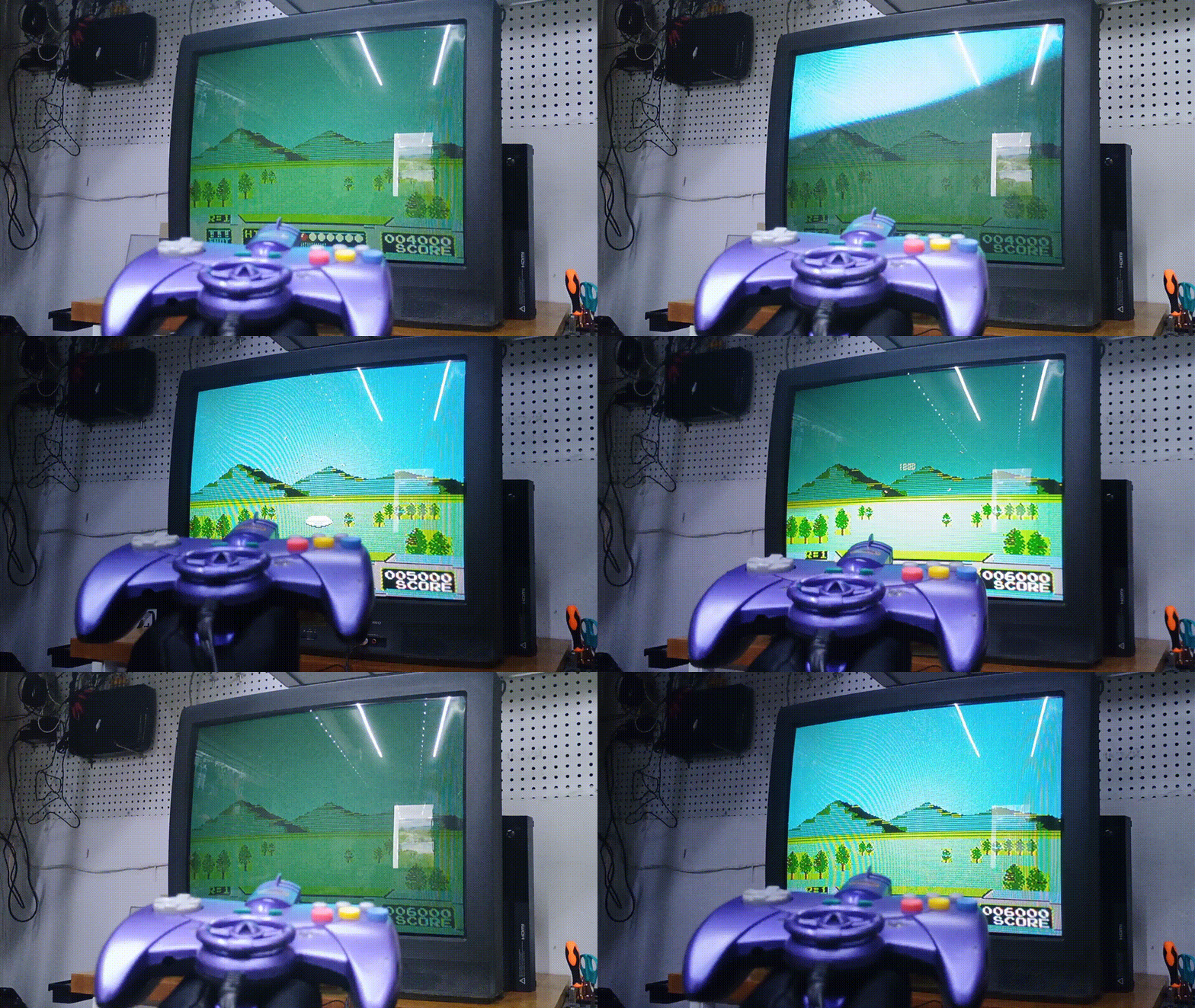
Surprisingly, yes. There’s a very clicky and positive trigger button on the bottom of the main unit. You can even use it without the grip attached if you’d rather your Player be a phaser rather than a pistol. So maybe you’d be best off just playing Duck Hunt and Hogan’s Alley forever. I mean, there are theoretically worse ways to spend eternity, but I can only think of two or three of them offhand.
I presume by now you’ve all watched James Rolfe’s review of the Action 52 cartridge and I’m not going to turn this into that. Reviewing every title on this stupid thing is unnecessary; they’re for the most part all just old Nintendo games, albeit sometimes versions that are mildly cursed. We’ve all seen most of them before.
I’ll only point out the exceptions.
“Super Panda.” It’s… Super Mario Bros. But it’s a sprite hack of Super Mario Bros., and somebody’s also taken the time to absolutely butcher the music. They didn’t rearrange any of the levels, though, so after you mute your TV and get over the controller just not working worth a damn, you can just play some good old Mario 1. Score one, I guess?
What about those big name titles? The ones that never came out on the NES?
Well, “King of Fighter” turns out to just be Yie-Ar Kung Fu. They didn’t even bother to hack the title screen. What about “Tekken?”. Yep, it’s Karateka. And “WWF” is the Japanese version of Tag Team Match M.U.S.C.L.E. which is, to be fair, a very goofy game. But I suck at it, and the controller really doesn’t help.
To be fair, it’s not unreasonable to get your hopes up for these fighters since there were some bootleg demakes of next gen fighting games made for the NES/Famicom, like the Hummer Team version of Street Fighter 2.. None of those are present on this cart, though.
There are a couple of bespoke, unlicensed titles on here. None of them are really any good. For instance, there’s “Aladdin 3” which has nothing to do with the Disney movie, but is rather an original bootleg game that’s a primitive sidescrolling shooter:

For some reason on this cart it’s had the title screen excised.
There’s also “Brush Roll,” with its nightmare inducing title screen:

This is a bootleg port of the Make Trax / Crush Roller arcade game.
The remainder of the games are just regular old NES or Famicom titles, but several of them have minor romhacks applied or are otherwise slightly scuffed. For instance, there’s “Facio B,” which turns out to be…

…“Mr. Mary,” which in turn is just the original Mario Bros. arcade game. I guess Facio B is supposed to be “Facio Bros.” Get it?
Several of the games are either bad ROM dumps, or have been very inexpertly modified. “Monkey” is particularly baffling, turning out to be a version of Donkey Kong Jr. that starts you on a later level, and also has all the palettes corrupted so that Jr. is black on a black background, and thus functionally invisible:

And several of the games have further had their title screens modified to either imply they’re a different or more advanced game. Space Invaders is renamed to “Space ET,” and Defender is named “Star Gate” after its sequel, even though it isn’t. NES Kung-Fu is named “SpartanX” for some reason. And so on, and so forth. More confusingly, some just have their title artwork removed entirely:

Some are jiggered to skip the title screens completely, and just drop you straight into the gameplay.
And then Arkanoid, for instance, for some reason has its title screen reduced to this:

Yeah, search me as to why.
And a handful of the games just don’t work. F1 Race, for instance, is on there. Theoretically the only game in the entire bundle appropriate for use with that stupid steering wheel. But it crashes when you try to play it. Every time.
There are a few decent games available out of those that aren’t butchered. Some of which we never got in America, like the Famicom Macross game. But eventually a pattern starts to emerge…
If you’re a big enough Nintendo nerd, you’ll ultimately realize that all of the games on this cartridge are either early titles that don’t use mappers at all, and the handful that do are without exception CNROM mapper games, which is one of the simplest mappers ever used on the Famicom/NES. (Contra is an example, and again is the only big ticket game on here.) It’s obvious that whatever system is inside this thing, it doesn’t support any other mappers, and that severely limits the types of games that can exist on it. So that means no Ninja Turtles, no Mario 2 and 3, no Final Fantasy, no Mega Man, no Kirby; you’ll never find any of those banger titles on here no matter how many thousand menu pages you scroll through. We didn’t even get any of the cool bootlegs like that version of Street Fighter 2.
And hell, it probably only supports the CNROM mapper because it’s the piece of hardware used to swap the rinky-dink game ROM’s in and out of memory in the first place.
Back up a minute. What the hell is a mapper, you say?
Graddad Rambles About More Old Nintendo Shit
You can probably tell just by looking at it that the original Famicom/NES is a pretty wimpy system. Out of the box it can only support games up to 40 kilobits, and even then what it can do with the data it’s got is fairly limited. Screen page mirroring can only happen in one direction at a time, for instance, and it hasn’t got enough memory to hold much more than one screenfull of tiles anyway. The solution to this ultimately turned out to be “mapper chips,” which are extra chips and pieces of hardware that can be placed inside the cartridge to expand the usable storage capacity as well as enable other functions that are probably too technical to get into here. Multidirectional scrolling is the classic example, which in order to accomplish on the NES outright requires a mapper chip. If you’ve ever wondered why there’s no verticality in Mario 1, why you can’t scroll backwards in Contra, and why there are so many early Nintendo games where all the action takes place on one screen – well, that’s why.
And the Power Player II’s system-on-a-cartridge doesn’t have the necessary hardware. So all you get out of it are pokey old early-days titles and Contra.
The Inevitable Conclusion
The Power Player II is a bootleg Famicom in disguise, packed full of aforementioned pokey old early-days titles. And Contra.
Its controller is crap, its ergonomics are questionable, and its design is baffling. (I didn’t even mention where the power button is. Go on, guess. No, you’re wrong. It’s the unlabeled decorative plastic triangle in the middle of the controller face. That took me a solid three minutes to figure out.)
But it’s also kind of bonkers. Its packaging and presentation provides no indication whatsoever as to what this thing actually is on the inside. How it goes about its functionality – packing (most of) an entire working Famicom clone system on a cartridge is such a stupefyingly bizarre way to go about it that I have to grant it a certain amount of begrudging respect. Who would ever think to do it that way?
But it also digs up what was a long buried and thankfully forgotten truth: All of these bootleg Famicom multigame things were crap. Like, without exception. In America we like to bemoan all the cool stuff from Asia that we never got here. Well, this kind of thing wasn’t one of them. Trust me, we didn’t miss out on much by not having ready access to loads of shoddily built, janky multicarts stuffed with looping menus full of nothing but the Japanese versions of all those black box launch title games.
But even coming from that inauspicious beginning, damned if this thing isn’t weird.