
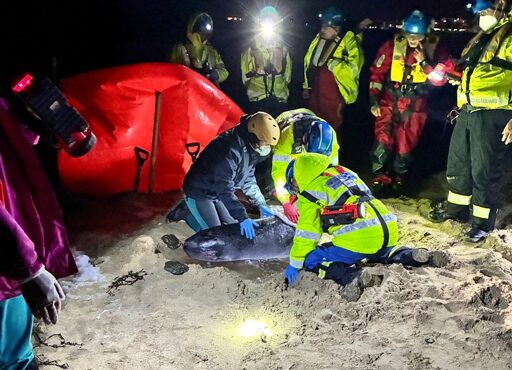
“Late on November 27, the British Divers Marine Life Rescue (BDMLR) received a call that would lead to one of the most significant cetacean sightings in recent UK history. A live-stranded whale had been found on a midnight beach in Trearddur Bay, Wales—and it turned out to be something truly exceptional.
The animal was a female pygmy sperm whale, measuring just 1.7 meters long. For context, there are fewer than 20 recorded sightings of this species in the entire UK. These elusive deep-water cetaceans are rarely seen alive, and encounters with this mysterious toothed whale are treasured events in marine science.
The young whale, likely still dependent on her mother or recently weaned, bore significant injuries from her stranding. Despite the best efforts of BDMLR Medics, attending veterinarians, and Coastguard rescue teams who worked through the night in cold, windy conditions, the animal was too compromised to be successfully returned to the sea. The decision was made to humanely euthanize her to end her suffering.
Yet even in this tragic situation, science prevailed. The necropsy and tissue collection provided invaluable data about this poorly understood species. Pygmy sperm whales possess one of nature’s most remarkable defense mechanisms: the ability to release an ink-like fluid from their gut, similar to the tactics of squids. By studying this individual’s biology, genetics, and health status, researchers gained crucial insights into the species’ lifestyle, threats, and physiology—knowledge that could help protect populations in the wild.”