

8·
1 day agoYeah, but I could also use a shortener. It’s more ergonomic, easier to use, edit etc. Different tools exist for a reason.
Yeah, but I could also use a shortener. It’s more ergonomic, easier to use, edit etc. Different tools exist for a reason.
While I agree on principle, we’re not always using big-name websites. The argument falls short for some-local-blog.com, there’s no security improvement on clicking that link as opposed to shortener.tld/blog-link. I’d say we should trust the source of the link instead of the link itself. Link shortening can be useful if you want long links to look nice when sharing, or simply for personal use so that you don’t need to remember long links to access an internal resource. Or just for personal websites. I can link my CV at https://domain.tld/cv instead of the full PDF file path, for example.
I was already using Vaultwarden for the server, just switched to Keyguard on Android and Desktop. Works perfectly.
There seems to be an open PR for a browser extension as well. Hope that’s merged soon.
(Also, Immich is another MVP.)
Even though I avoid everything Microslop and Adobe like the plague, I think it’s a good thing overall. There are many who would like to use Linux, but can’t due to their work needing Office 365 or Adobe Creative Suite. If someone manages to make the latter work in Linux somehow, a large number of people will be enticed to switch to Linux.
For most “normal” setups, no. Networks, environment variables, volumes, permissions etc. map pretty much one-to-one.
If you’re using compose, you can even keep your setup mostly unchanged and use podman compose. Although, I would recommend learning a bit about quadlets and using them instead. There’s a tool called podlet that can help you translate your docker commands to quadlets, although it’s not complete and does miss some features. The annoying thing can be some QoL tooling that exists for docker compose that doesn’t for quadlets e.g. automatic restart for changed quadlet files. I wrote some scripts for most of these situations. I will probably release them at some point after I make sure that they don’t rely on any specific properties of my setup. But you can easily write them for yourself if you know some shell scripting.
For docker run commands, you can mostly get away with changing it to podman run.
Yes, my sister uses Gnome, and I’m basically her IT support. I just don’t see any reason for switching. It’s too limiting for me.
I also used it for a month or two on my own machine before I switched back.
I’ve been using KDE for about a decade now. It’s polished, and works well. Plus, it’s also highly customizable, so I’ve never had a reason to switch.
The question has been answered. But since you seem to be new to containers, I’ll just give you a recommendation. Just use podman. It can do pretty much everything that docker is used for, but it’s rootless by default.
Thanks. Hope you like it.
That could be, but I don’t think that it should be relied upon. The shortener itself can execute malicious code, so that kind of security is, in my opinion, essentially theatre. I’d just say that don’t click on links that you don’t trust.
This project is for own use/use with friends/family/internally in an org etc., where trust isn’t an issue. Of course, I cannot stop anyone from using it in any other way that they see fit. It can help shorten annoying long links for ease of sharing, but that’s it.
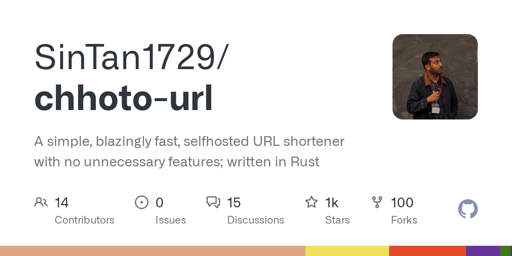
OIDC was requested quite a few times. I finally understood the point when I started using it for my selfhosted apps lol. It can be very convenient.