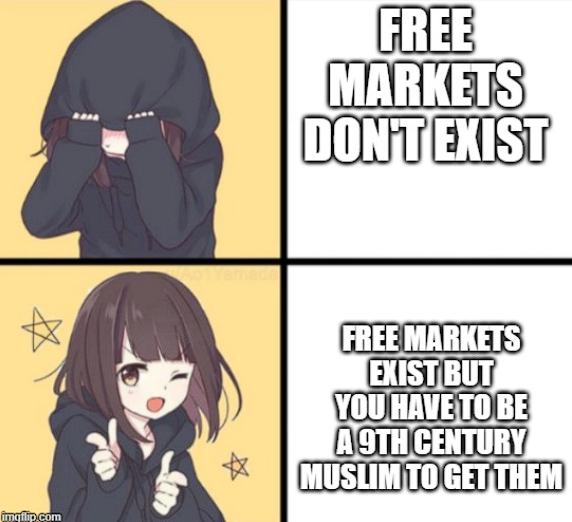
Explanation: David Graeber’s Debt: The First 5000 years has a section talking about this (it’s the one about Islam in the Middle Ages for those interested), but basically Medieval Muslim society collaborated to actively keep the state away from people’s day to day lives, leading to a system where the whole market ran on honor and good vibes. Unsurprisingly, this looked nothing like the world “free market enthusiasts” envision, at least partially because it was impossible without the Islamic ban on usury. Relevant excerpt:
Large-scale merchants were referred to as sahib al-mal, “owners of capital,” and legal theorists spoke freely about the creation and expansion of capital funds. At the height of the Caliphate, some of these merchants were in possession of millions of dinars and seeking profitable investment. Why did nothing like modern capitalism emerge? I would highlight two factors. First, Islamic merchants appear to have taken their free-market ideology seriously. The marketplace did not fall under the direct supervision of the government; contracts were made between individuals-ideally, “with a handshake and a glance at heaven”-and thus honor and credit became largely indistinguishable. This is inevitable: you can’t have cutthroat competition where there is no one stopping people from literally cutting one another’s throats.
-Debt page 303
A point that’s not mentioned here specifically is that this was also before the invention of corporations with shareholders. That means that each business still had an owner who could be held personally responsible for the actions of that business. That would prevent a lot of the nasty shit we see going around today.
Nothing dumber than a capitalist basically saying, “The government needs to stay out of my fictional entity created by governments to shield me from legal liability in order for me to stimulate the economy and generate tax revenue.”
I mean even today there are CEOs and boards of directors that can be held responsible; this is a matter of political will. Which, well, Marx didn’t call liberal democracy the dictatorship of the bourgeoisie for no reason.
Respectfully, Marx taking about the bourgeoisie specifically, would not refer to the richest of the rich. Think of it how the UK would refer to a “middle class” person which is very different than how Americans understand it.
We’re effectively ruled by a new age aristocracy, where money=nobility. Unfortunately it’s getting a bit worse than Marx predicted.
I’m not 100% on top of my Marx, but AFAIK to Marx the bourgeoisie were all members of society who own capital and whose income comes from the profits of hiring wage laborers to operate that capital. If the ultra-rich were a proper aristocracy you’d see the rest of the bourgeoisie try (and succeed) to bring them down; instead they just bicker every now and then but close ranks whenever bourgeois society is threatened. For the most part these two groups make more sense as subcategories of one class than as two separate classes, with the feudalistic behavior of the ultra-rich just being the result of divisions within the wider ruling class.
Unfortunately it’s getting a bit worse than Marx predicted.
How so?
Very interesting, I never read that before. Thanks for providing the context!