You must log in or register to comment.
a gallon of water boils in 10 minutes on a whirlpool electric range in turbo mode
My favourite part of the metric system is that with it’s water weight being 1-1 with volume; measuring liquids is super easy with a scale.
Having read a good portion of the comments in this thread and the anti-american sentiment attached, I am convinced that the only reason the US isn’t wholly metric at this point is out of spite.
I know the actual reason is that it would cost too damn much to convert all the infrastructure we’ve built in imperial, but now I just want the USA to keep kicking everyone in the balls at the Olympics, in the military, and with global corporate supremacy just to own it to the world that they’re better than all of you AND they use imperial.
When I learned the consistency (synergy?) between metric measures, I thought that was so amazing.
In the olden days sciencey types and engineers kept fact books listing such relations. They had a specific name that escapes me.
Before handheld calculators, they also kept books of pre-calculated mathematical operations, so they were used to having numbers books around.
I want this but with diet coke.

One mole of hydrogen-1 isn’t 1 gram because of the binding energy of protons and neutrons. One mole of hydrogen-1 is about 1.008g
We need to go deeper, america needs to come up with new time measurements too. Everything must go!
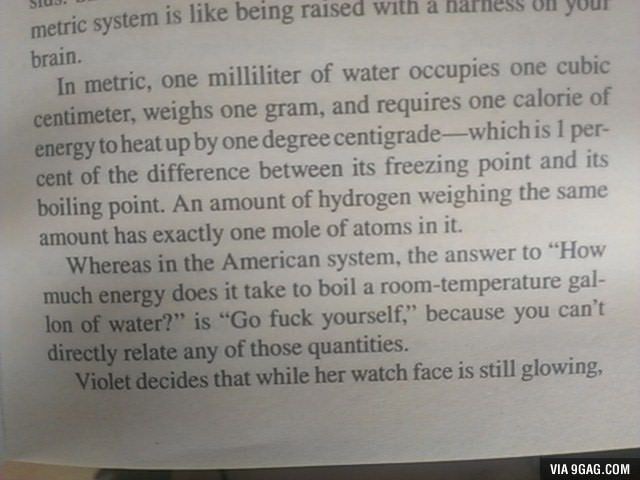
Wild Thing by Josh Bazell, in case anyone was wondering what book that is.
Found out recently that a fluid ounce of water doesn’t weigh an ounce, and that makes me mad
A pints a pound
I think that’s all we got
This is how I found out that Americans don’t even have full pints.
The UK doesn’t want to give up pints of beer because they’re bigger than a half liter.
American ones are smaller.
Wait, no, this isn’t really correct.
Metric is the first part, but it is also the second part. The entire point of imperial units is that they ARE humanistically intuitive measurements.
Science = metric, relatable = imperial.
Imperial doesn’t care about how many units of energy it takes to boil x quantity of water at y elevation pressure etc, and that’s the whole point, it’s about how many approximately hands tall is this horse. You look at your hand, look at the horse, and go “about 15”. If you want to know exactly how tall a horse is, relative to human height, you use feet and inches. Everything has its own, weird systems of measurement that got made up over time, organically relative to other human approximation.
Metric if you want standardization and exactness and conversion, but imperial works fine as long as you know of the units, because we make up our own units that make sense. Like, the south park kouric unit is an example. It doesn’t matter what the unit is derived from, you just need to know is it ten or eleven or twelve, because the units are relative to us, not how many units of energy it takes to heat a cubic meter of water to boiling at exactly one atmosphere, because that’s insane. Cool, and converts well and is universal, but the numbers don’t really mean anything.
I really think context matters, and if you work well with metric for everything - fantastic. If you work well with imperial - great. They’re just different systems for different purposes for different situations.
We have also units in metric, except it’s always the same ones. Horse is around 2m and a small banana is 15cm, a human foot in around 30cm.
You can measure the parts of your body to get to the same point reference pretty fast and it’s very relatable when you live in a non-imperial country.
How much is a kilohorse
Imperial doesn’t use multiplicative prefixes very much.
Instead, they would invent a new random unit, the skyscraper, which is equal to a random number of horses, like 176.
And then everyone goes “Yeah, a skyscraper is 176 horses, everyone knows that.”
That is 1,000 horses, obviously.
Metric is very relatable if you just, use it, just like imperial.
The only difference is metric is also easy to scale up or down, imperial is pure “fee-fees”
Your implication that metric is not humanistically intuitive is just bonkers when you consider 99.125% of the developed world just uses metric for their every day, always, with no issue.
Germans, Koreans, and Indians aren’t suddenly going “oh no! I can’t measure these shoes and these plates! I only have SCIENCE numbers, not BaldEagleBananaBurgerFreedom™ numbers!”
Only if you’re used to it.
I expanded my comment, but, basically, you can get used to any system. Humans are incredibly adaptable.
But for the same reason we’re bad at conceptualizing how rich a trillionaire really is, metric may not be better than imperial. Or, maybe imperial is the reason we’re bad at conceptualizing! I haven’t thought about that before! But it’s an interesting idea!
Like, I’m at a shop right now, and outside the window are some scooters.
How many scooters?
I think in units of scooters, not pieces of metal in scooter shape that add up to a volume of mass and energy. Because that’s not what I’m thinking about right now, I just see six scooters, and you instantly know that there are six scooters.
There are four scooters
But you don’t measure the number of scooters by the gram either.
This is true, but that’s because everybody has accepted the unit of scooter as the accepted unit count for scooters…
Okay that’s a bad example, because just counting things is the way to count things. But also, maybe that’s the point - maybe, counting things is just super simple, and why direct or single-level abstract measurements is the difference: metric = relating everything to a single point, and imperial = just counting. Yeah? Maybe?
I’m not really following. What, are we counting feet, then? Mine?
Feet are just really entrenched in the way Americans think about lengths. It may not sound like it’s abstract, but it is. If I said “yeah, it’s about sixteen hands long”, people would have to parse wtf I’m talking about, but then have to grapple with how long a “hand” is exactly and what 16 of them means.
Depends on how into feet the person is
The foot is no less arbitrary than the meter. If you are just unfamiliar with the unit and confused by the fact it’s named after something often close in size to it that’s fine, but keep in mind for a while a meter was defined as the length of a specific metal rod, same as the foot and yard.
I was with you until you said the foot is no less arbitrary than the meter. The foot is just a useful size and changed depending on whenever the king decided. The meter was defined by the French using Earth. To say they’re both equally arbitrary is untrue.
Imperial units are nice to work in when accuracy is more important than precision. Want a third of a foot, that’s four inches exactly. A third of a meter is 33.333 cm repeated. It really depends on the situation which is more useful, but metric is more often than not the useful choice.
Yeah, they’re both arbitrary. You agree with me.
The “things” being counted in either respect are abstract and are only “known” if they are familiar.
Getting these two after eachother is fate

Violet
Huh. I must have missed this book in A Series of Unfortunate Events.
Did she undelete her account?
How unfortunate
True except for calorie. Metric typically uses Joules, which is good because it’s just the product of force (N) and distance units (m), instead of requiring a conversion factor.
If by “metric system,” you mean SI. But then, SI uses m3 for volume, not litres. The author didn’t specify which metric system, so this could be valid.
1m3 = 1 kiloliter so maybe they use both
I can’t remember what book this was from, it was a medical thriller about an ex-con in witness protection IIRC. I think it also includes him sending an intern to check on “the LD50 of falling out of a window”
yeah I need 100 interns and we gotta keep raising the window until half of them die when we chuck 'em out. In this proposal to the irb, we posit that no harm is done to live animals [irb cod of conduct §§121.74-121.76] cause they’re interns