You must log in or register to comment.
When I learned the consistency (synergy?) between metric measures, I thought that was so amazing.
In the olden days sciencey types and engineers kept fact books listing such relations. They had a specific name that escapes me.
Before handheld calculators, they also kept books of pre-calculated mathematical operations, so they were used to having numbers books around.

One mole of hydrogen-1 isn’t 1 gram because of the binding energy of protons and neutrons. One mole of hydrogen-1 is about 1.008g
We need to go deeper, america needs to come up with new time measurements too. Everything must go!
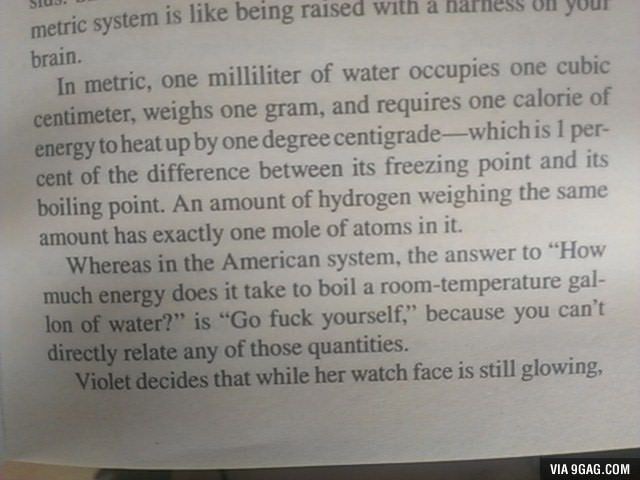
Wild Thing by Josh Bazell, in case anyone was wondering what book that is.
Found out recently that a fluid ounce of water doesn’t weigh an ounce, and that makes me mad
Wait, no, this isn’t really correct.
Metric is the first part, but it is also the second part. The entire point of imperial units is that they ARE humanistically intuitive measurements.
Science = metric, relatable = imperial.
Imperial doesn’t care about how many units of energy it takes to boil x quantity of water at y elevation pressure etc, and that’s the whole point, it’s about how many approximately hands tall is this horse. You look at your hand, look at the horse, and go “about 15”. If you want to know exactly how tall a horse is, relative to human height, you use feet and inches. Everything has its own, weird systems of measurement that got made up over time, organically relative to other human approximation.
Metric if you want standardization and exactness and conversion, but imperial works fine as long as you know of the units, because we make up our own units that make sense. Like, the south park kouric unit is an example. It doesn’t matter what the unit is derived from, you just need to know is it ten or eleven or twelve, because the units are relative to us, not how many units of energy it takes to heat a cubic meter of water to boiling at exactly one atmosphere, because that’s insane. Cool, and converts well and is universal, but the numbers don’t really mean anything.
I really think context matters, and if you work well with metric for everything - fantastic. If you work well with imperial - great. They’re just different systems for different purposes for different situations.
Metric is very relatable if you just, use it, just like imperial.
The only difference is metric is also easy to scale up or down, imperial is pure “fee-fees”
Your implication that metric is not humanistically intuitive is just bonkers when you consider 99.125% of the developed world just uses metric for their every day, always, with no issue.
Germans, Koreans, and Indians aren’t suddenly going “oh no! I can’t measure these shoes and these plates! I only have SCIENCE numbers, not BaldEagleBananaBurgerFreedom™ numbers!”
Only if you’re used to it.
I expanded my comment, but, basically, you can get used to any system. Humans are incredibly adaptable.
But for the same reason we’re bad at conceptualizing how rich a trillionaire really is, metric may not be better than imperial. Or, maybe imperial is the reason we’re bad at conceptualizing! I haven’t thought about that before! But it’s an interesting idea!
Like, I’m at a shop right now, and outside the window are some scooters.
How many scooters?
I think in units of scooters, not pieces of metal in scooter shape that add up to a volume of mass and energy. Because that’s not what I’m thinking about right now, I just see six scooters, and you instantly know that there are six scooters.
But you don’t measure the number of scooters by the gram either.
This is true, but that’s because everybody has accepted the unit of scooter as the accepted unit count for scooters…
Okay that’s a bad example, because just counting things is the way to count things. But also, maybe that’s the point - maybe, counting things is just super simple, and why direct or single-level abstract measurements is the difference: metric = relating everything to a single point, and imperial = just counting. Yeah? Maybe?
I’m not really following. What, are we counting feet, then? Mine?
Feet are just really entrenched in the way Americans think about lengths. It may not sound like it’s abstract, but it is. If I said “yeah, it’s about sixteen hands long”, people would have to parse wtf I’m talking about, but then have to grapple with how long a “hand” is exactly and what 16 of them means.
The foot is no less arbitrary than the meter. If you are just unfamiliar with the unit and confused by the fact it’s named after something often close in size to it that’s fine, but keep in mind for a while a meter was defined as the length of a specific metal rod, same as the foot and yard.
I was with you until you said the foot is no less arbitrary than the meter. The foot is just a useful size and changed depending on whenever the king decided. The meter was defined by the French using Earth. To say they’re both equally arbitrary is untrue.
Imperial units are nice to work in when accuracy is more important than precision. Want a third of a foot, that’s four inches exactly. A third of a meter is 33.333 cm repeated. It really depends on the situation which is more useful, but metric is more often than not the useful choice.
Yeah, they’re both arbitrary. You agree with me.
The “things” being counted in either respect are abstract and are only “known” if they are familiar.
Getting these two after eachother is fate

Violet
Huh. I must have missed this book in A Series of Unfortunate Events.
Did she undelete her account?
How unfortunate
True except for calorie. Metric typically uses Joules, which is good because it’s just the product of force (N) and distance units (m), instead of requiring a conversion factor.
If by “metric system,” you mean SI. But then, SI uses m3 for volume, not litres. The author didn’t specify which metric system, so this could be valid.
I can’t remember what book this was from, it was a medical thriller about an ex-con in witness protection IIRC. I think it also includes him sending an intern to check on “the LD50 of falling out of a window”
Metric is great for scientists in a lab with equipment to measure things.
Imperial was created during a time when peasants in the middle of nowhere needed to measure something “close enough” to trade with others, even without tools or measuring equipment, which was only owned by scribes and other members of the nobility.
This is why all imperial length measurements relate to parts of the body and why all volume and weight measurements relate to containers that were commonly used to store the thing you’re measuring (a bushel of grain, for example).
Also, a foot can be divided equally into 2, 3, 4, or 6 equally-sized pieces without resorting to estimation or irrational numbers; a meter cannot.
The US agreed to switch to the metric system centuries ago, but the ship carrying the official units sank on the way over.
In imperial, pounds can be either a mass or a force, or context dependent, or a slug might be the unit for mass derived from the pound force. The foot pound force is a unit for energy.
Honestly the system shouldn’t exist.
Metric is great for scientists in a lab with equipment to measure things.
Metric is just as great for everyday life as imperial units.
Also, a foot can be divided equally into 2, 3, 4, or 6 equally-sized pieces without resorting to estimation or irrational numbers; a meter cannot.
While I agree in principle, I also enjoy the chaos that imperial system causes when you try adding up 1 1/8 inches + 5 27/32 inches + 7 3/16 inches instead of just using decimal numbers.
Edited for clarity
Metric is just as great for everyday life as imperial units.
This is what the metricians say to feel better about themselves, but they never mean it.
“Oh yes, I’ll have a 236.588 milliliters of tea, thank you for offering”
“The kids are out playing in the back 0.914 meters”
“Doctor, I think I broke my left 30.48 centimeters”
Do you see how silly you would sound if you didn’t use imperial?
I was co confused until I got the joke lol
1 1/8 inches + 5 27/32 inches + 7 3/16 inches
1/8 = 4/32
3/16 = 6/32
4 + 6 + 27 = 37
37/32 = 1 5/32
1 + 5 + 7 + 1 = 14
Total: 14 5/32
I wouldn’t call it chaos, it’s a straightforward algorithm:
- Identify the largest denominator
- Multiply each other fraction by [largest denominator divided by current fraction’s denominator] (e.g. 32/8 = 4, so 1/8 * 4/4 = 4/32)
- Determine the sum of every numerator
- Divide and simplify the number if necessary
- Determine the sum of the integers, including any integers added in the previous step
This works for every measurement because the denominator is always a power of 2.
With that said I absolutely prefer metric.
In practice you would just use decimal inches. Doesn’t really make it better but you can machine something without ever seeing a fraction if you want to since everything will be in thousandths of an inch.
Maybe in your particular industry, but I reckon most people using imperial units aren’t using measuring devices with decimal inches or needing the precision of .0001"
If someone were adding those figures they would switch to decimal. I built furniture for 2 years, 64ths are almost never used over thousands of an inch. If you need to be finer than 32nds you use thou. And that pretty much only for wood. Machine shop I worked in used thou exclusively.
thousands of an inch
Which is called a “mil”, a name that has never caused confusion
Is it really? That’s really interesting, and would cause a lot of confusion in metric-English countries where ‘mil’ is pejoratively used in speech to either mean ‘millimetre’ or ‘millilitre’ depending on context.
It causes confusion in the US too, because, despite popular misconceptions, we do in fact use both systems.
While in theory it is like that, I as a non english speaker have come across people trying to add up inch fractions more time than I remember.
Having done my share of automotive and carpentry work, I’ve never in my life had to go down to 64ths. 32nds is the smallest fraction I’ve ever had to use and the amount of times I’ve had to get that small could probably be counted on one hand.
In US machine shops if they’re getting down to that level of measurement, they’ll switch over to milli-inches.
Yes, milli-inches are an actual unit in use.
Are you saying adding 8ths, 16ths and 32nds is trivial and having 64th in my example made it unrealistic?
I’m saying that if you knew what you were talking about you wouldn’t be working in 64ths in the first place. You picked 64ths because “hurr sure Americans dumb” and you know it.
I picked 64 because I don’t use imperial and I have no sense of scalw what makes sense as a fraction unit. A bit paranoid, aren’t you?
I picked 64 because I don’t use imperial and I have no sense of scalw what makes sense as a fraction unit.
Exactly
A bit paranoid, aren’t you?
Nope, just sick of arrogant Europeans acting like they’re experts on shit they don’t have the first clue about.
You come to a thread where people throw light hearted banter about each others’ measuring systems and you feel attacked by arrogant europeans. Sounds a lot like paranoia. Chill.
Wheeeeeeee fractions!
But after multiplying, 8 + 54 + 3 over 64 is just clean fun, you end up with 14 1/64 inches and wanna die because you accidentally cut the material at 14 inches and now your whole day is ruined.
“Decimalized currency is great for all those labcoats, but for us regular ol’ normal folk, it’s much easier to use real, easily divisible livres, which can be divided into 20 sous and subsequently into 12 deniers.”
“In fact, imperial is so great because duodecimal invites so much divisibility! What’s that? You’re saying it goes 12 –> 3 –> 1760 for length, 16 –> 2000 for units of mass, that units of volume are a bastardized base-2 system where there isn’t even a consistent multiple between units, and that pounds and short tons aren’t cleanly divisible by 3? And that not a single unit of volume is divisible by 3 unless you bring it down to the level of teaspoons?”
“‘Why not just switch to a fully duodecimal system if divisibility is so important to you’, you ask? Well fuck you, a foot is about as long specifically as my forearm, and there’s no way my poor, emaciated monkey brain would ever have found something similar to latch onto with SI units. Those people living in most of the rest of the world probably just carry meter sticks around up their asses. ‘How many square inches is a 30 x 30-foot room?’, you ask? Well fuck you again.”
I hate imperial. But I do think it would be neat if we had also changed our common numeral system to base 12 when making metric. Dividing by 3 and 4 is WAY more common than dividing by 5.
But no way that would happen unless we had a massive linguistic shift occur as well. Base 10 is too rooted in our culture.
Jesse, what the fuck are you talking about?
I thought I was clowning on a tired Gish gallop of flimsy, ad hoc justifications for imperial/US customary.Any concerns over anything I said in particular?Edit: He can’t keep getting away with it!
No… I was just joking
https://knowyourmeme.com/memes/jesse-what-the-fuck-are-you-talking-about
The best part is that Walter White, as a science teacher, would probably agree.
Oooh. I misread that as “Jesus”. LMAO
Every country used a system based off body parts or similarly easy-to-measure parts. When the metric system was invented, most of them switched because it was the logic thing to do. Some just decided that the dumb system was better who knows why.
Spain adopted the metric system in 1852 and by the time, they weren’t the most advanced country.
Spain adopted the metric system in 1852 and by the time, they weren’t the most advanced country
perhaps when the u.s. finally reaches the level of 1852 spain, americans will switch too.
Metric allows you to convert between length volume and mass in your head. Someone smarter than me could probably take a reasonable estimate of how long a kettle will take to boil just by knowing it’s wattage and estimating its volume.
You’re right that “pounds” may have e been a practical measurement back when people didn’t have calibrated and everyone’s hand weighed a pound. However, that advantage ceased once everyone standardised those measurements.
A metre is equally divisible by 50, 25, 20, 10, 5, and 2. There arr numerous advantages to a base 10 system.
The last bit of rationalizing is hilarious. It’s like you don’t even understand numbers or math, well what am I saying, you’re an American
We can figure out what 70% of a meter is.
Good luck with your peasant system
What do you mean you can not divide a meter without estimations or irrational numbers? Do you mean fractions or decimal? 1m/3=3.33… dm ( repeating, which means it is a rational fraction)
Anyone who thinks you can divide one number by another and get an irrational number… doesn’t know what irrational means.
Irrational numbers are ones with the square root of negative 1 as a factor, right?
irrational numbers are numbers which are not a ratio of integers
complex numbers, often called “imaginary” numbers, are ones with components of unit i =√-1
complex numbers, often called “imaginary” numbers,
Aside: mostly, but complex numbers are an addition of both a real number and an imaginary number: a + bi. It just happens that a can be 0, making it a strictly irrational number when b ≠ 0.
Thus, the imaginary numbers are a strict subset of the complex numbers.
Also, US Customary units share many of the same terms as Imperial, but the actual quantities differ.
Even more fun is that US customary units are explicitly defined by their metric equivalents. So the US is using metric whether they like it or not, they just slap pointless conversion factors on top.
And it’s been this way since 1893. The US customary system has been sneaky metric that whole time.
I’d just like to point out that this example has TWO metric volume units (mililiters and cubic centimeters) and that they’re not equivalent (ie 1 liter is not equal to one cubic meter), AND the weight of water is 1 gram and also doesn’t align with EITHER of those volumes in terms of scale because they randomly made their mass unit the size of a grain of rice for some fucking reason??? AND the calorie is ALSO not ever used, because it’s so small. We use the kilo calorie as standard (or Calorie) for nutrition of all kinds.
Like… They could have made the meter smaller, so a cubic meter was 1 liter, which was 1 gram of water and 1 calorie of energy.
Like… They fucked up the metric system so bad guys. It’s so monumentally stupid. They made it from scratch and still couldn’t get it right. There’s two definitions of ‘million’? Like, a mili meter is 1/1000 of a meter (not a millionth) because ‘thousand’ and ‘million’ both used to just mean ‘real big number’, but rather than pick one to use they used both??? So a Mega meter is a million meters, but a mili meter is a thousandth.
It’s just so dumb. Like… Memorizing 20 prefixes is NOT any better than just having bespoke (albeit redundant) measurements for different purposes. Like, I’m not measuring my commute in inches. That’s dumb. And for the record, science uses non metric units ALL THE GODDAMN TIME because it’s way better to have tools specific to your trade. Here’s some non metric length units off the top of my head: light-year, sol, angstrom, parsec, planck length. No one is telling astronomers to stop using light years.
You know what else isn’t metric??? Fucking time. Because having a year be 1000 days long is stupid, for reasons I hope I don’t have to explain. No one complains that we have 12 months in the year, because a month is based on lunar cycles and not just ‘the number 10 is special.’ We appear to be doing just fine with 60 seconds and 60 minutes and 24 hours and 7 days and 52 weeks.
In short, this debate has always been incredibly stupid, and is constantly perpetuated by people who have no idea what the fuck they’re talking about.
- mL and cc are the same thing.
- 1 Liter is equal to 1dm³ (which no one uses really but it doesn’t matter since the equivalency is at mL = cc
- a grain of rice is about 0.02 gr so idk where you got that from. Weights were manufactured originally as was the meter (platinum cylinder and bar respectively, the originals are still in a museum in Paris)
- weight is now based off the Planck constant and the meter is based off the speed of light. (2019)
- Calorie, while metric is not an SI unit, that would be the joule.
- the SI uses a hodgepodge of units and not all metric, they are however, all based off of natural constants.
- A yard is just as arbitrary as anything else, it was a rod made somewhere around the 1500’s and was kept in London. Nowadays much like any other imperial unit, the sizes are based off their metric counterparts. is 1yd = 0.9144m exactly.
- Metric time has been attempted (1000 ticks in a day) didn’t work super well. But like I said theres a ton of non metric units in the SI.
Seconds are SI, I believe, and it makes perfect sense to talk milliseconds, kiloseconds, etc.
If someone gives me instructions in kiloseconds, I’m stabbing them.
Hah, no doubt. But it can make sense in some contexts. I wouldn’t mind using it for daily use personally, it’s about 15 minutes.
The 24 hour clock is fine but it’s much easier to do integer math with seconds.
of course a liter isn’t 1 cubic meter. it’s 1000cc, while a cubic meter is 1,000,000cc. that’s just math.
There’s only one definition of million, because “mil” means thousandth.
Also, the metric system generally uses Joules rather than calories. A Joule is the energy it takes to exert a force of 1 Newton over the distance of 1 meter. An example would be lifting about 102 grams up 1 meter.
These non-metric units that science uses all the time are conveniences based on constants we can measure or estimate. An AU is the distance from the Earth to the Sun. A sol is the time it takes for Mars to rotate once about its axis. There’s nothing wrong with making up constants that make your numbers easier to explain.
While our calendar isn’t a base-10 system, the second is defined by the metric system and that’s the definition everyone uses.
While I’m American, and I’m used to feet, inches, pounds, miles, gallons, and cups, it is easy to understand the convenience of the Metric system. How many inches are in a mile? Well, it’s 5280 feet, and there are 12 inches in a foot, so that means there’s 63,360 inches in a mile. For the record, it’s easier to figure how many centimeters are in a mile.
A mile is officially defined as 1609.344 meters, so all you have to do is multiply by 100. There are 160,934.4 centimeters in a mile. There are 100,000 centimeters in a kilometer.
Pounds, by the way, are a unit of force, not mass. Or rather, they used to be. So now they’re a unit of mass, but you can still refer to pounds of force. So a pound of force is the force of gravity on a one pound mass. To quote Wikipedia,
Note, however, unlike the other systems the force unit is not equal to the mass unit multiplied by the acceleration unit[11]—the use of Newton’s second law, F = m ⋅ a, requires another factor, gc, usually taken to be 32.174049 (lb⋅ft)/(lbf⋅s2).
Yikes. The metric system is certainly better.
They probably made the meter about a yard because that’s roughly 1 stride (left step right step)
Which is what’s really cool about imperial. It’s very human, for length and temperature at least. A mile is about a 20 minute walk, 0-100 degrees is about the range most people can endure with reasonable comfort, and I have no idea what the volume measurements are based on. 1 cup is what a small child drinks in a sitting, a quart is more than a normal adult drinks, and teaspoons/tablespoons are really only useful in baking, and even then it’s only sometimes
They must’ve had really weird table wear when they standardized imperial
A kilometer is about a 15 minute walk (meaning you can walk ca 4 km in one hour - actually a bit less, avg walking speed is around 3.6km/h, but that is so very much individual that it has the same usability as your mile in 20 minutes).
0 and 100 °C is where water changes between frozen/liquid/vapor (and that does NOT change, while “reasonable comfort” is very much dependent on humiditiy - if it’s close to 0° outside, expect slippery roads. 0 and 100 Fahrenheit do tell you fuck all about what to expect outside regarding road conditions without extra knowledge.) Default room temperature is around 22°C, smack in the middle of the personal preference normally being around 20-25°. Having the same scale in mind, everything above 30°C is pretty warm, with 42° the current heat record in Austria, set this year. 60° is the temperature where proteins start to denature a.k.a getting burnt, pretty much 2/3 of the way to water vapor.
One liter is the volume that fits in a 10x10x10 cm cube, just as a milliliter is the volume of a 1x1x1 cm cube (because 10x10x10=1000, and a milliliter is a thousand of a liter). we still use tea/tablespoons in many cooking recipes tho (or if you want, you can use 5 and 25 ml or 5 and 25g if it’s water.)
the meter was originally defined to be one 10,000-th of the distance from the equator to the north pole, along the meridian that passes through Paris
The mile is based on roman steps originally : 1000 steps.
The yard was an arm’s length.
Fahrenheit 0 is pure invention. 100 was body temp.
100 was meant to be body temp, life is filled with little imperfections
To be fair, it would be the same answer even if we used the metric system.
Yeah, but in one the math is super easy and you don’t need to throw in 6 conversion factors.
Okay, then, how much energy does it take to boil 1mL of water from room temperature? (Note that I said “boil,” not raise it to 100°C.)
We will assume that room temperature is 20° C. The heat of enthalpy is 2257 kJ/kg, or 2.257 kJ/g. As stated previously, the amount of energy to raise water 1 degree is 1 cal, which also equals 4.184 J. So,
(100-20) × 4.184 + 2257 =
80 × 4.184 + 2257 =
334.72 + 2257 =
2592 J rounded to the nearest whole number. This will leave you with a dry pot.
Now show me the process using Fahrenheit, fluid ounces, and foot-pounds.
It’s about 1 BTU per fluid ounce per degree Fahrenheit, so:
128 fl oz × (212 - 68)°F × 1BTU/fl oz•°F = 18,432 BTU
Add in the enthalpy of vaporization:
7.5 BTU/fl oz × 128 fl oz = 960 BTU
So, about 19,392 BTU.
I’m cooking pasta for dinner, and I didn’t do any calculations. I just put the water in the pot on the stove, and waited for it to boil. Which was kind of the point of my question. Metric is all neat and elegant, but that’s irrelevant in daily life, because if I did have to calculate the energy requirement, I’d have to look up the enthalpy value, because it’s not memorable, as well as figuring in the actual atmospheric pressure to determine the actual boiling temperature. It makes all the sense in the world to use SI where it matters (e.g. science experiments), but customary units persist because in so much of daily life, it doesn’t matter.
So your argument is we don’t need this in everyday life. Sure, that’s sort of true, but I guarantee this was necessary in making a stove that would work in your area. But also true is that if it doesn’t matter that much in day-to-day life, then the only reason to keep such a clunky system is familiarity.
Also, 1 BTU is the amount of energy to raise the temperature of 1 pound of water 1 degree F. So your calculations are already off by a factor of 128. Given the world doesn’t need you to know the numbers for water to boil, that doesn’t affect much, but perhaps the vastly higher number for heating the water versus the amount of energy to get the water to vaporize should have clued you in that something was weird. It’s easy to tell in metric because most of the dimensional conversion values are 1 or factors of 10.
There are people who like to dismiss the value of knowledge because it isn’t important in their daily lives. This is only true if you live in a hut where the only sources of force are human, animal, or fire, or there is someone unseen that you rely on who has used those tools extensively to provide you a life where knowing that isnt necessary. Raising the bar with ridiculous conversion calculations every step of the way makes understanding these concepts more difficult for the layperson and makes the field harder to enter.