They probably made the meter about a yard because that’s roughly 1 stride (left step right step)
Which is what’s really cool about imperial. It’s very human, for length and temperature at least. A mile is about a 20 minute walk, 0-100 degrees is about the range most people can endure with reasonable comfort, and I have no idea what the volume measurements are based on. 1 cup is what a small child drinks in a sitting, a quart is more than a normal adult drinks, and teaspoons/tablespoons are really only useful in baking, and even then it’s only sometimes
They must’ve had really weird table wear when they standardized imperial
A kilometer is about a 15 minute walk (meaning you can walk ca 4 km in one hour - actually a bit less, avg walking speed is around 3.6km/h, but that is so very much individual that it has the same usability as your mile in 20 minutes).
0 and 100 °C is where water changes between frozen/liquid/vapor (and that does NOT change, while “reasonable comfort” is very much dependent on humiditiy - if it’s close to 0° outside, expect slippery roads. 0 and 100 Fahrenheit do tell you fuck all about what to expect outside regarding road conditions without extra knowledge.) Default room temperature is around 22°C, smack in the middle of the personal preference normally being around 20-25°. Having the same scale in mind, everything above 30°C is pretty warm, with 42° the current heat record in Austria, set this year. 60° is the temperature where proteins start to denature a.k.a getting burnt, pretty much 2/3 of the way to water vapor.
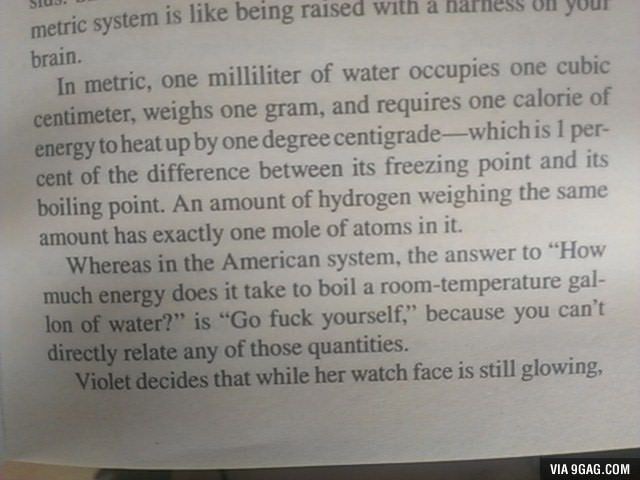
One liter is the volume that fits in a 10x10x10 cm cube, just as a milliliter is the volume of a 1x1x1 cm cube (because 10x10x10=1000, and a milliliter is a thousand of a liter). we still use tea/tablespoons in many cooking recipes tho (or if you want, you can use 5 and 25 ml or 5 and 25g if it’s water.)


They probably made the meter about a yard because that’s roughly 1 stride (left step right step)
Which is what’s really cool about imperial. It’s very human, for length and temperature at least. A mile is about a 20 minute walk, 0-100 degrees is about the range most people can endure with reasonable comfort, and I have no idea what the volume measurements are based on. 1 cup is what a small child drinks in a sitting, a quart is more than a normal adult drinks, and teaspoons/tablespoons are really only useful in baking, and even then it’s only sometimes
They must’ve had really weird table wear when they standardized imperial
the meter was originally defined to be one 10,000-th of the distance from the equator to the north pole, along the meridian that passes through Paris
A kilometer is about a 15 minute walk (meaning you can walk ca 4 km in one hour - actually a bit less, avg walking speed is around 3.6km/h, but that is so very much individual that it has the same usability as your mile in 20 minutes).
0 and 100 °C is where water changes between frozen/liquid/vapor (and that does NOT change, while “reasonable comfort” is very much dependent on humiditiy - if it’s close to 0° outside, expect slippery roads. 0 and 100 Fahrenheit do tell you fuck all about what to expect outside regarding road conditions without extra knowledge.) Default room temperature is around 22°C, smack in the middle of the personal preference normally being around 20-25°. Having the same scale in mind, everything above 30°C is pretty warm, with 42° the current heat record in Austria, set this year. 60° is the temperature where proteins start to denature a.k.a getting burnt, pretty much 2/3 of the way to water vapor.
One liter is the volume that fits in a 10x10x10 cm cube, just as a milliliter is the volume of a 1x1x1 cm cube (because 10x10x10=1000, and a milliliter is a thousand of a liter). we still use tea/tablespoons in many cooking recipes tho (or if you want, you can use 5 and 25 ml or 5 and 25g if it’s water.)
The mile is based on roman steps originally : 1000 steps.
The yard was an arm’s length.
Fahrenheit 0 is pure invention. 100 was body temp.
100 was meant to be body temp, life is filled with little imperfections