1 Liter is equal to 1dm³ (which no one uses really but it doesn’t matter since the equivalency is at mL = cc
a grain of rice is about 0.02 gr so idk where you got that from. Weights were manufactured originally as was the meter (platinum cylinder and bar respectively, the originals are still in a museum in Paris)
weight is now based off the Planck constant and the meter is based off the speed of light. (2019)
Calorie, while metric is not an SI unit, that would be the joule.
the SI uses a hodgepodge of units and not all metric, they are however, all based off of natural constants.
A yard is just as arbitrary as anything else, it was a rod made somewhere around the 1500’s and was kept in London. Nowadays much like any other imperial unit, the sizes are based off their metric counterparts. is 1yd = 0.9144m exactly.
Metric time has been attempted (1000 ticks in a day) didn’t work super well. But like I said theres a ton of non metric units in the SI.
of course a liter isn’t 1 cubic meter. it’s 1000cc, while a cubic meter is 1,000,000cc. that’s just math.
There’s only one definition of million, because “mil” means thousandth.
Also, the metric system generally uses Joules rather than calories. A Joule is the energy it takes to exert a force of 1 Newton over the distance of 1 meter. An example would be lifting about 102 grams up 1 meter.
These non-metric units that science uses all the time are conveniences based on constants we can measure or estimate. An AU is the distance from the Earth to the Sun. A sol is the time it takes for Mars to rotate once about its axis. There’s nothing wrong with making up constants that make your numbers easier to explain.
While our calendar isn’t a base-10 system, the second is defined by the metric system and that’s the definition everyone uses.
While I’m American, and I’m used to feet, inches, pounds, miles, gallons, and cups, it is easy to understand the convenience of the Metric system. How many inches are in a mile? Well, it’s 5280 feet, and there are 12 inches in a foot, so that means there’s 63,360 inches in a mile. For the record, it’s easier to figure how many centimeters are in a mile.
A mile is officially defined as 1609.344 meters, so all you have to do is multiply by 100. There are 160,934.4 centimeters in a mile. There are 100,000 centimeters in a kilometer.
Pounds, by the way, are a unit of force, not mass. Or rather, they used to be. So now they’re a unit of mass, but you can still refer to pounds of force. So a pound of force is the force of gravity on a one pound mass. To quote Wikipedia,
Note, however, unlike the other systems the force unit is not equal to the mass unit multiplied by the acceleration unit[11]—the use of Newton’s second law, F = m ⋅ a, requires another factor, gc, usually taken to be 32.174049 (lb⋅ft)/(lbf⋅s2).
They probably made the meter about a yard because that’s roughly 1 stride (left step right step)
Which is what’s really cool about imperial. It’s very human, for length and temperature at least. A mile is about a 20 minute walk, 0-100 degrees is about the range most people can endure with reasonable comfort, and I have no idea what the volume measurements are based on. 1 cup is what a small child drinks in a sitting, a quart is more than a normal adult drinks, and teaspoons/tablespoons are really only useful in baking, and even then it’s only sometimes
They must’ve had really weird table wear when they standardized imperial
A kilometer is about a 15 minute walk (meaning you can walk ca 4 km in one hour - actually a bit less, avg walking speed is around 3.6km/h, but that is so very much individual that it has the same usability as your mile in 20 minutes).
0 and 100 °C is where water changes between frozen/liquid/vapor (and that does NOT change, while “reasonable comfort” is very much dependent on humiditiy - if it’s close to 0° outside, expect slippery roads. 0 and 100 Fahrenheit do tell you fuck all about what to expect outside regarding road conditions without extra knowledge.) Default room temperature is around 22°C, smack in the middle of the personal preference normally being around 20-25°. Having the same scale in mind, everything above 30°C is pretty warm, with 42° the current heat record in Austria, set this year. 60° is the temperature where proteins start to denature a.k.a getting burnt, pretty much 2/3 of the way to water vapor.
One liter is the volume that fits in a 10x10x10 cm cube, just as a milliliter is the volume of a 1x1x1 cm cube (because 10x10x10=1000, and a milliliter is a thousand of a liter). we still use tea/tablespoons in many cooking recipes tho (or if you want, you can use 5 and 25 ml or 5 and 25g if it’s water.)


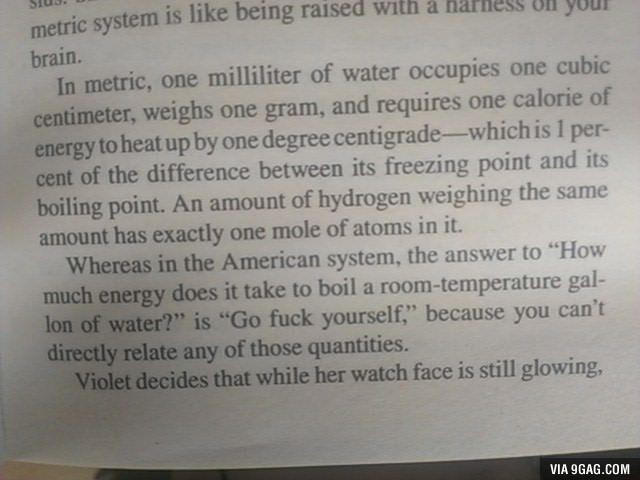
deleted by creator
Seconds are SI, I believe, and it makes perfect sense to talk milliseconds, kiloseconds, etc.
If someone gives me instructions in kiloseconds, I’m stabbing them.
i have bad news for you about how computers do timestamps.
Hah, no doubt. But it can make sense in some contexts. I wouldn’t mind using it for daily use personally, it’s about 15 minutes.
The 24 hour clock is fine but it’s much easier to do integer math with seconds.
of course a liter isn’t 1 cubic meter. it’s 1000cc, while a cubic meter is 1,000,000cc. that’s just math.
There’s only one definition of million, because “mil” means thousandth.
Also, the metric system generally uses Joules rather than calories. A Joule is the energy it takes to exert a force of 1 Newton over the distance of 1 meter. An example would be lifting about 102 grams up 1 meter.
These non-metric units that science uses all the time are conveniences based on constants we can measure or estimate. An AU is the distance from the Earth to the Sun. A sol is the time it takes for Mars to rotate once about its axis. There’s nothing wrong with making up constants that make your numbers easier to explain.
While our calendar isn’t a base-10 system, the second is defined by the metric system and that’s the definition everyone uses.
While I’m American, and I’m used to feet, inches, pounds, miles, gallons, and cups, it is easy to understand the convenience of the Metric system. How many inches are in a mile? Well, it’s 5280 feet, and there are 12 inches in a foot, so that means there’s 63,360 inches in a mile. For the record, it’s easier to figure how many centimeters are in a mile.
A mile is officially defined as 1609.344 meters, so all you have to do is multiply by 100. There are 160,934.4 centimeters in a mile. There are 100,000 centimeters in a kilometer.
Pounds, by the way, are a unit of force, not mass. Or rather, they used to be. So now they’re a unit of mass, but you can still refer to pounds of force. So a pound of force is the force of gravity on a one pound mass. To quote Wikipedia,
source
Yikes. The metric system is certainly better.
Now I’m thinking about the tiniest cats, thanks.
They probably made the meter about a yard because that’s roughly 1 stride (left step right step)
Which is what’s really cool about imperial. It’s very human, for length and temperature at least. A mile is about a 20 minute walk, 0-100 degrees is about the range most people can endure with reasonable comfort, and I have no idea what the volume measurements are based on. 1 cup is what a small child drinks in a sitting, a quart is more than a normal adult drinks, and teaspoons/tablespoons are really only useful in baking, and even then it’s only sometimes
They must’ve had really weird table wear when they standardized imperial
A kilometer is about a 15 minute walk (meaning you can walk ca 4 km in one hour - actually a bit less, avg walking speed is around 3.6km/h, but that is so very much individual that it has the same usability as your mile in 20 minutes).
0 and 100 °C is where water changes between frozen/liquid/vapor (and that does NOT change, while “reasonable comfort” is very much dependent on humiditiy - if it’s close to 0° outside, expect slippery roads. 0 and 100 Fahrenheit do tell you fuck all about what to expect outside regarding road conditions without extra knowledge.) Default room temperature is around 22°C, smack in the middle of the personal preference normally being around 20-25°. Having the same scale in mind, everything above 30°C is pretty warm, with 42° the current heat record in Austria, set this year. 60° is the temperature where proteins start to denature a.k.a getting burnt, pretty much 2/3 of the way to water vapor.
One liter is the volume that fits in a 10x10x10 cm cube, just as a milliliter is the volume of a 1x1x1 cm cube (because 10x10x10=1000, and a milliliter is a thousand of a liter). we still use tea/tablespoons in many cooking recipes tho (or if you want, you can use 5 and 25 ml or 5 and 25g if it’s water.)
the meter was originally defined to be one 10,000-th of the distance from the equator to the north pole, along the meridian that passes through Paris
edit: sorry, one ten-millionth, not one ten-thousandth. a kilometer is a ten-thousandth, and obviously a meter is a thousandth of that
The mile is based on roman steps originally : 1000 steps.
The yard was an arm’s length.
Fahrenheit 0 is pure invention. 100 was body temp.
i think 0 F was the freezing point of salt water, but far saltier than seawater - as salty as it can possibly get.
It’s a weird mix of salt, water and other things. And not even saturated AFAIK.
100 was meant to be body temp, life is filled with little imperfections